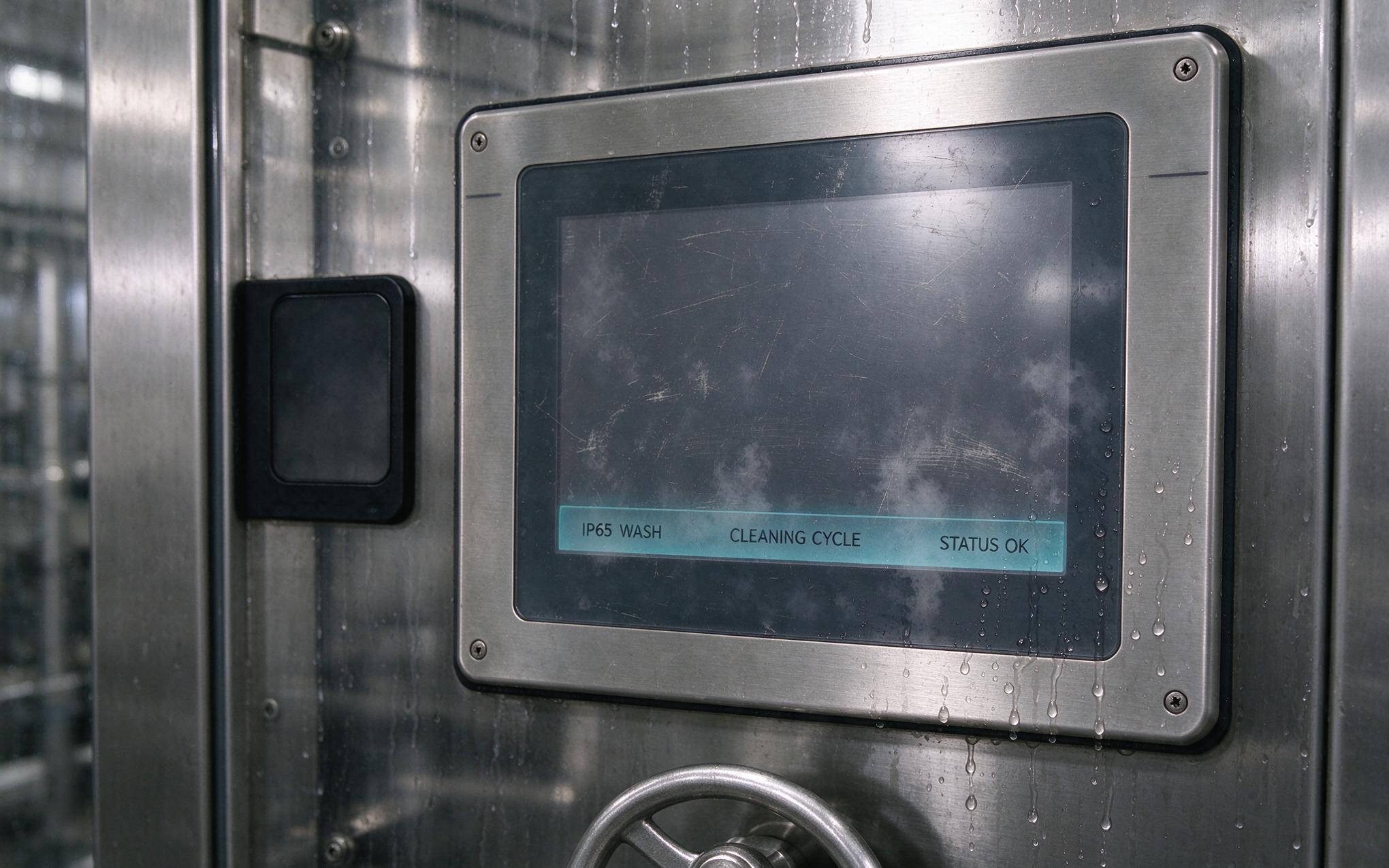
Sanitation crews on a dairy or meat processing line do not treat equipment gently. A washdown shift means water near 80 degrees Celsius leaving a lance at 80 to 100 bar, aimed at every surface that could harbor bacteria, and the operator terminal is not excluded. A waterproof industrial monitor that ran for two years in a machine shop can fail within weeks of that treatment. The failure is rarely a dramatic flood: moisture shows up as haze behind the glass, a touch layer registers phantom presses, or corrosion creeps along a connector shell. Those failures trace back to one gap in understanding, which is how differently IP69K loads a seal compared with IP65.

Why IP69K Loads a Waterproof Industrial Monitor Differently
IEC 60529 defines IP65 with a 12.5 mm nozzle at roughly 0.3 bar from three meters, which is a rain and hose test. IP69K, defined in ISO 20653, uses a fan jet at 80 to 100 bar and up to 80 degrees Celsius from as close as 100 mm. Pressure differs by more than two orders of magnitude, and the thermal component matters just as much. Hot water striking a cool enclosure raises skin temperature quickly while internal air stays cooler, then that air cools again once spraying stops. The cycle drives a pressure differential across every seal, and a gasket only has to lift a few micrometers during the negative phase to draw moisture inward. This is why an industrial ip65 touch screen can pass its certificate and still accumulate internal condensation on a sanitation schedule. A rating describes a static ingress test, so a waterproof industrial monitor for sanitation duty must be judged against the cycling instead.

Gasket Compression Set and Fastener Torque Discipline
A sealed bezel works because the gasket is held at a specified compression, typically 20 to 30 percent of its free height, distributed evenly around the perimeter. Two mechanisms erode that. Compression set is the permanent deformation an elastomer retains under load at elevated temperature, and repeated hot water contact accelerates it, so a gasket that started at 25 percent compression may deliver far less after a year of daily cycles. The second mechanism is uneven fastener torque: tightening screws sequentially around the perimeter rather than in a diagonal pattern pulls one side down early, leaving a low compression zone that becomes the ingress path. To counter that, industrial hardware manufacturers, including KOXIAN, machine continuous gasket grooves instead of relying on flat adhesive strips, since a captured groove controls compression height mechanically. Caustic and acidic cleaning agents attack some elastomers, so chemical compatibility belongs in the specification.

Mounting Geometry and Drainage for a Waterproof Industrial Monitor
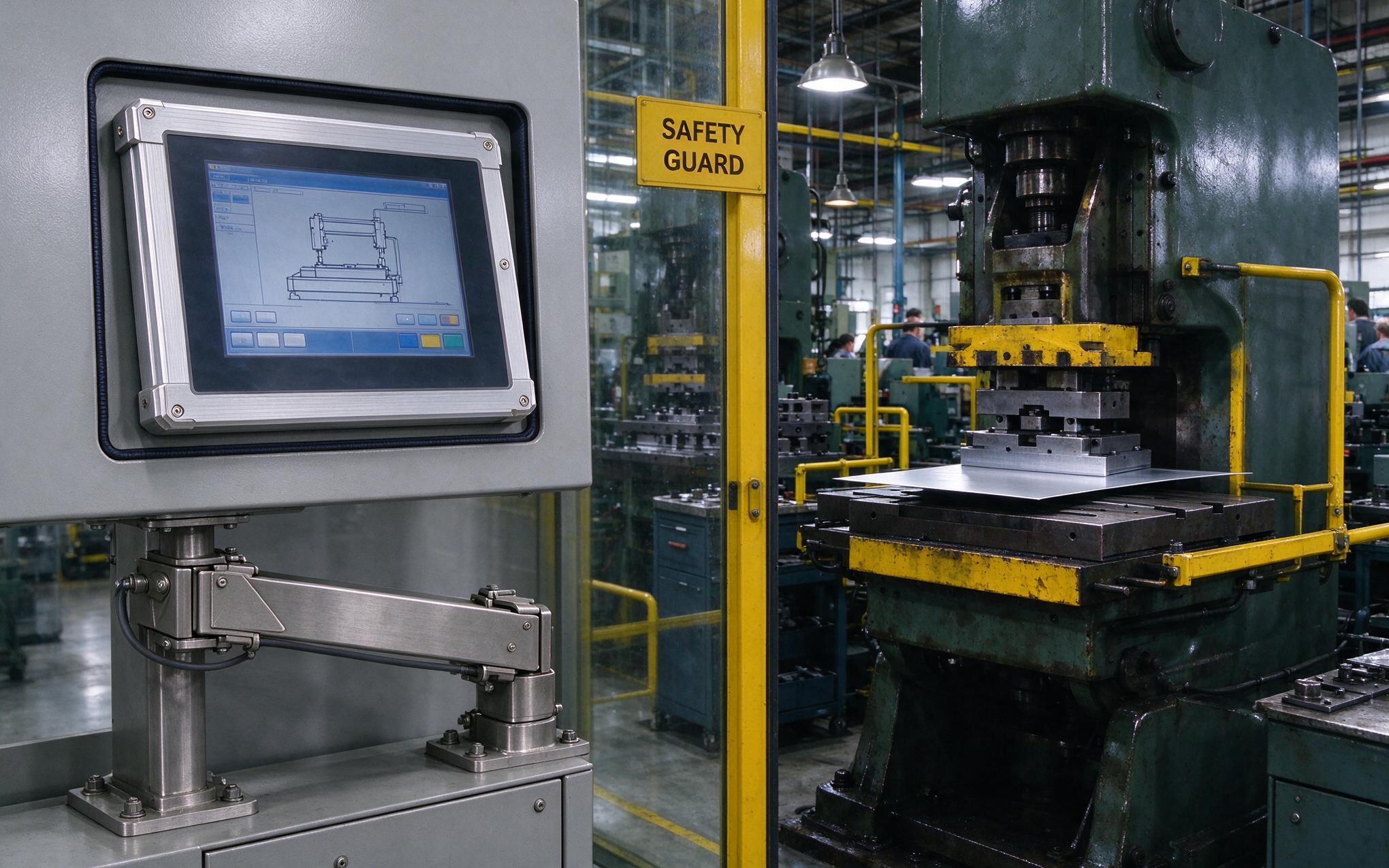
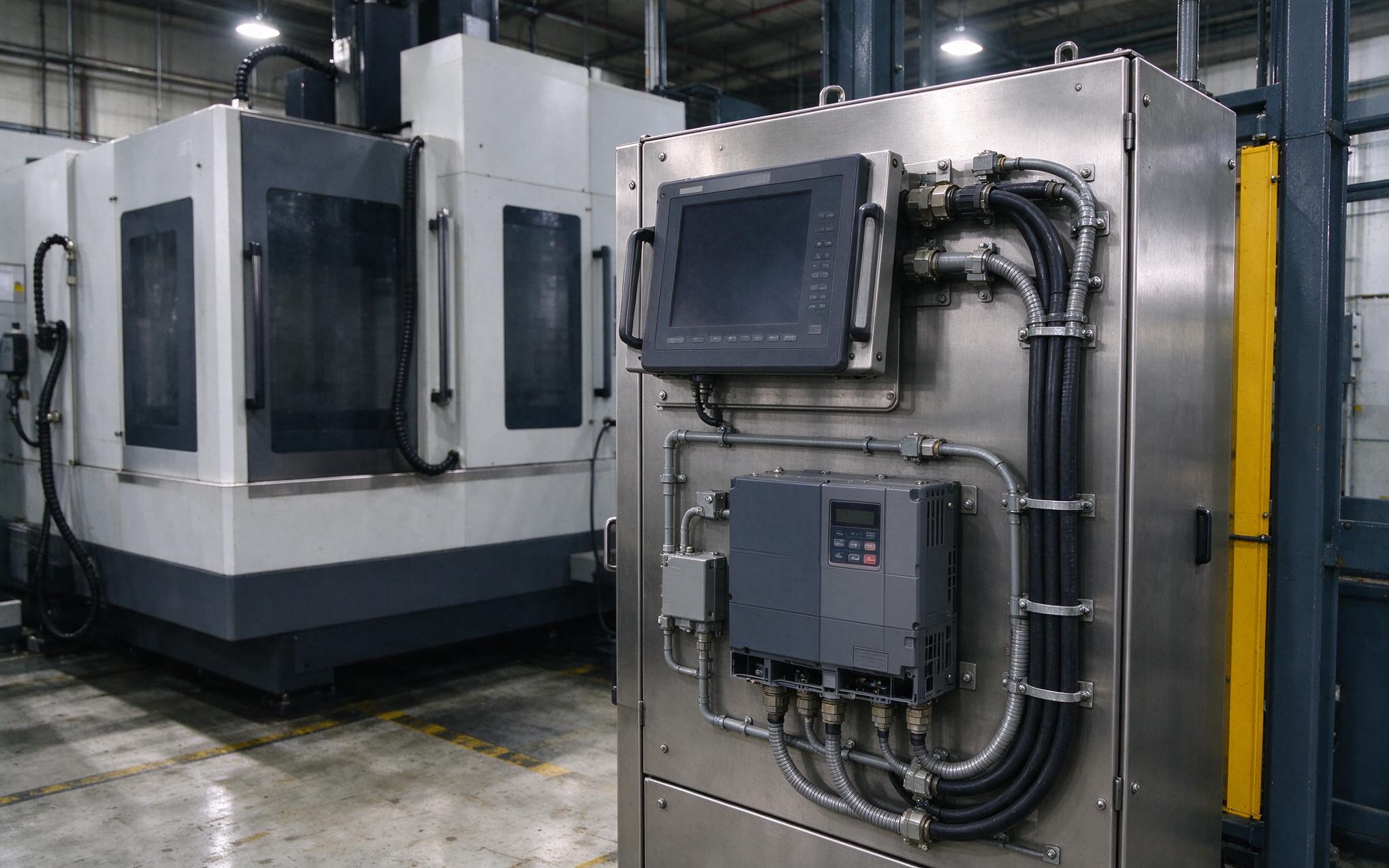
Sealing performance is decided as much by the panel as by the display. An industrial panel mount monitor clamped into a cutout with a bowed or burred edge cannot compress its gasket evenly, and sheet metal that flexes under fastener load relaxes later. Cutout flatness should be checked with a straight edge before installation, and thin panels benefit from a stiffening frame. Orientation matters equally: a vertical face creates a horizontal ledge at the lower bezel where water sits against the seal for hours after the shift ends. Tilting the assembly a few degrees downward turns that ledge into a drainage path. When specifying hardware here, design approaches like those adopted in KOXIAN stainless enclosure builds show how radiused corners and sloped upper surfaces avoid the flat areas hygienic audits flag. An untorqued rear gland defeats an otherwise sound waterproof industrial monitor.

Specifying and Verifying for Daily Sanitation Duty
A purchase specification should state the rating, the housing material, and the verification method together. Stainless 304 covers most food plants, while 316 suits environments where chlorides are present. The rating must apply to the complete enclosure rather than the front face alone, because a front rated assembly with a painted steel rear box corrodes from behind. Acceptance testing earns its cost: a spray cycle at the plant’s actual lance pressure, temperature, and standoff distance, followed by internal inspection after several thermal cycles, reveals more than a datasheet line. Recording gasket part numbers and torque values keeps the seal serviceable, since a waterproof industrial monitor reassembled with a reused gasket rarely returns to its original performance.
Washdown environments break equipment through cycling rather than through a single flood event. Pressure differentials from thermal shock, compression set in the gasket, uneven fastener load, and standing water at a flat lower bezel each add leakage risk that accumulates across a plant’s sanitation calendar. Specifying full enclosure protection, verifying cutout flatness, tilting the assembly for drainage, and replacing gaskets at every service interval addresses all four, at far less cost than an unplanned line stop.