A shutdown traced to a cabinet row that shifted during a moderate tremor usually reveals damage nowhere near the frame. The cabinet stayed upright, the anchors held, and yet several units stopped communicating because slide rails deformed enough to load connector housings at the rear. A rackmount industrial pc mounted on telescoping rails behaves differently under lateral acceleration than a bolted panel assembly, and the rails become the weakest element in the load path. Anchoring calculations that stop at the cabinet base miss this entirely, because the frame can meet its rating while the equipment inside accumulates damage that surfaces days later as intermittent faults.

Beyond the Cabinet Base and Into the Rail Load Path
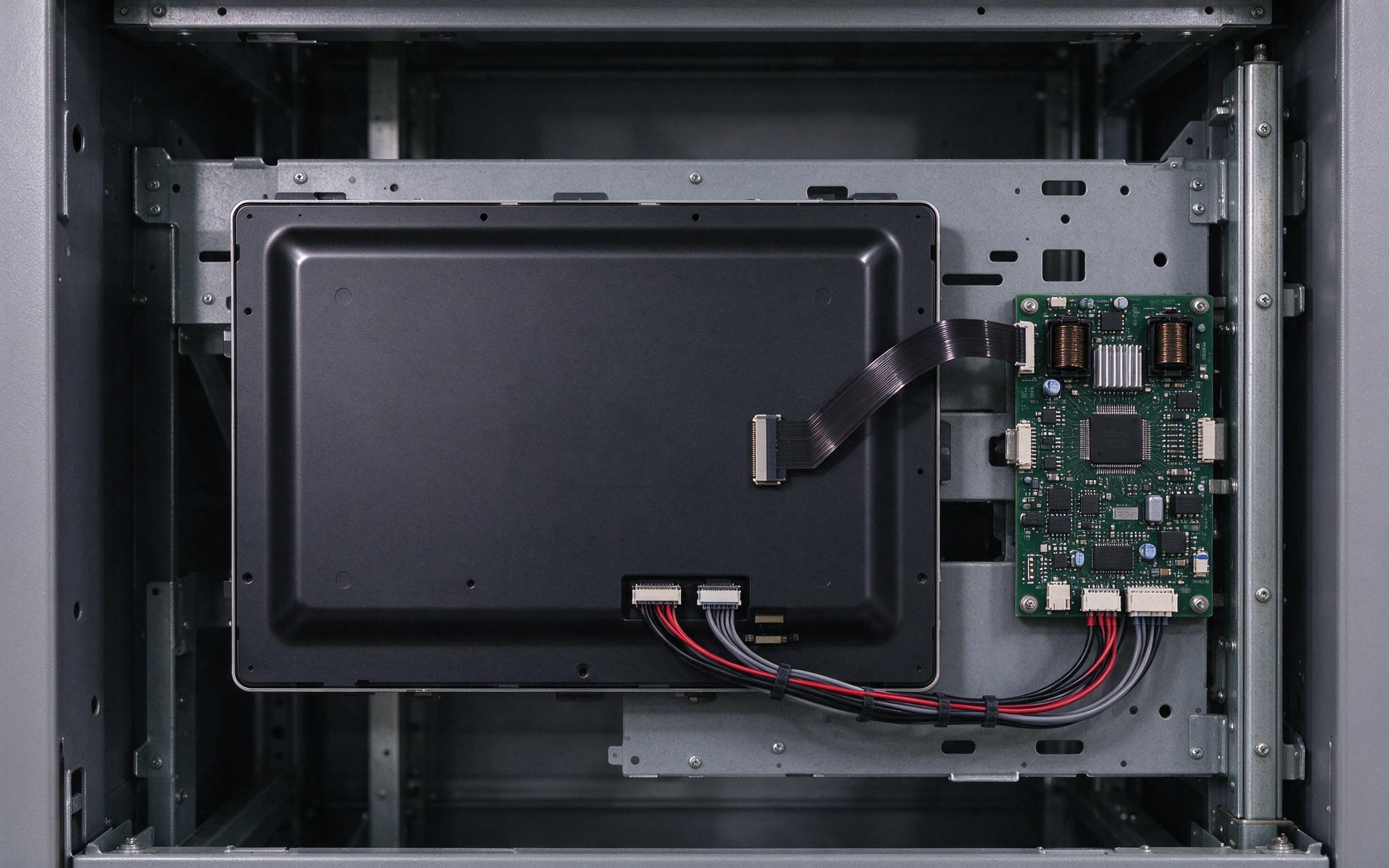
Anchor sizing normally treats the cabinet as a rigid body, computing base shear and overturning moment from the total mass and the design acceleration. That model is correct for the anchors themselves and silent about what happens between the rails and the equipment. Under lateral input a chassis on telescoping rails moves relative to the frame, and the bearings transfer that motion into the mounting ears and rear support. Chassis depth compounds this. A short unit near the front posts stays close to the stiff part of the frame, while a full-depth rackmount industrial pc reaches the region where rails deflect most and the chassis rear can travel several millimeters. That travel is absorbed by whatever is plugged in at the rear, typically the connector field rather than a structural member. Rail selection and rear support therefore carry as much weight as anchor selection, and neither appears in a base-shear calculation.

Under Combined Vertical and Lateral Acceleration
Rail load ratings published by industrial hardware vendors such as KOXIAN state static vertical capacity, which is not the governing case during ground motion. Rail ratings for embedded industrial pc and rackmount platforms are quoted the same way. Seismic input combines vertical and horizontal acceleration, and the vertical component can unload a rail bearing while the lateral component drives the chassis sideways. A bearing under reduced normal force resists lateral travel poorly, so the components interact rather than add independently. Two mitigations address this directly. Fixed brackets replace telescoping rails on a rackmount industrial pc where front removal covers service access, eliminating bearing travel entirely. Where slide access is required, a rear tie bracket coupling the chassis to the rear posts restores a second load path without blocking extension. Both shift load out of the rail bearings and into members the cabinet rating already covers.

Within Cabinet Rows and Baying Interactions
Rows of bayed cabinets do not respond as a set of independent structures. Bolting adjacent frames raises stiffness and reduces individual sway, but couples the row so motion at one end transfers along the line. An end cabinet sees higher acceleration than one near the middle, so identical mounting across the row leaves each rackmount industrial pc under unequal demand. Row position belongs in the mounting specification. Deployment guidance for platforms including those from KOXIAN commonly recommends fixed brackets rather than slide rails for the heaviest units, and applying that rule preferentially at row ends addresses the amplification without rebuilding every cabinet. Placement can also be sequenced, with the heaviest rackmount industrial pc positioned low and toward the row center where frame and anchors see the least amplified demand.

After the Event and Through the Inspection Cycle
Damage from a seismic event is frequently latent. A connector partially unseated by rail travel still passes continuity, a rail bearing that has taken a permanent set still slides, and a chassis whose mounting ear has yielded slightly still sits in the rack. All three degrade over following months and surface as intermittent faults that resist diagnosis because nothing appears broken. A structured inspection avoids that outcome: rail extension force compared against the as-installed feel, connector housings checked for witness marks, and mounting ear holes examined for elongation. Documented rail replacement intervals for a rackmount industrial pc after a design-level event remove the judgment call from the technician. Service documentation from vendors including KOXIAN often lists rail hardware as a consumable after a design-level event, which is a reasonable default for any rack row. The inspection costs little against a fault that takes weeks to isolate, and it is the step most often skipped when the row looks undamaged from the aisle.
Seismic qualification of a cabinet row is not complete when the anchors are sized. The load path continues through the rails, the rear support, and the baying connections, and each segment can fail at accelerations the frame tolerates without difficulty. Fixed brackets for heavy chassis, rear ties where slide access is required, attention to row position, and a defined post-event inspection together close the gap between a compliant cabinet and equipment that still runs afterward.