Field crews bolt a rugged PC monitor to a shaded loading dock door on one job and to a sun facing yard kiosk on the next, expecting the same hardware to keep working. Outdoors, that assumption fails quietly. Direct sun attacks a display on two fronts at once: ultraviolet photons age the organic films that form the image, while infrared energy heats the liquid crystal cell past its design point. Decisions based only on nit ratings miss both mechanisms. A sound selection process separates permanent photochemical damage from reversible thermal effects, then matches optical stack, brightness control, and front sealing to the duty profile of each mounting position.
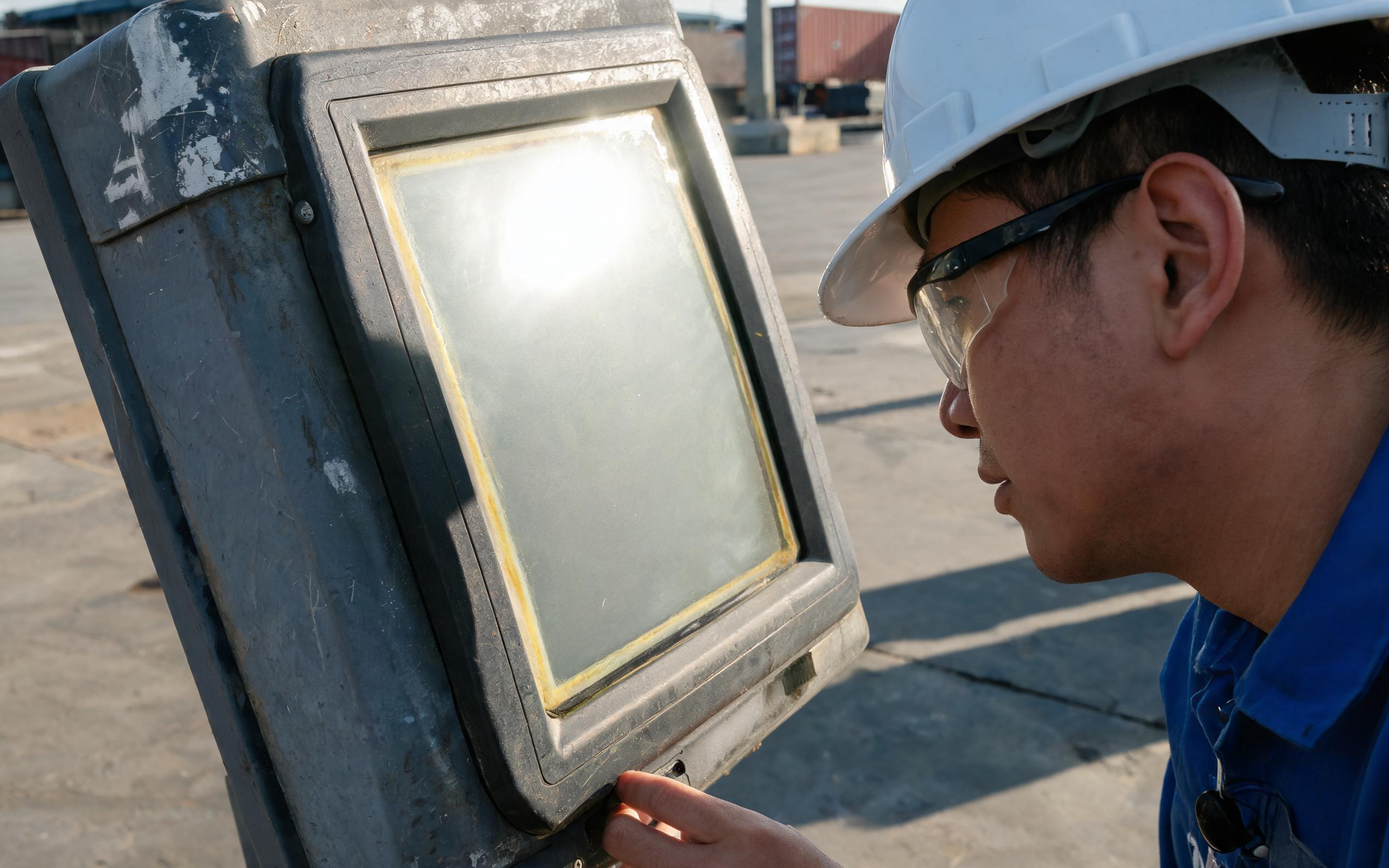
UV Dose and Polarizer Fade in Sun Facing Optical Stacks
An LCD forms contrast through two polyvinyl alcohol polarizer films doped with iodine. Radiation in the 280 to 400 nanometer band breaks those iodine bonds, shifting white toward yellow and cutting polarizer transmission from about 42 percent to under 30 percent in field samples. Indoor panels see under 10 watts per square meter of ultraviolet energy; exposed kiosks receive 50 to 100, so eight hours of direct sun adds roughly a month of indoor dose in a day. The shift stays invisible for six to twelve months and then accelerates at panel edges. Outdoor grade units use dichroic dye films rated past 50,000 hours and cover glass blocking wavelengths below about 380 nanometers. Specifying a rugged PC monitor without that UV blocking front layer treats a chemical failure as a brightness problem.

Managing Solar Clearing and Backlight Heat Build Up
Direct insolation near 1,000 watts per square meter heats the cell well above ambient even on cool mornings. Field observations from freight yard deployments show that KOXIAN-based outdoor monitor configurations pair high Tni wide temperature cells with conductive aluminum back chassis, moving heat toward mounting brackets instead of trapping it behind black bezels. Past its clearing point, the liquid crystal loses contrast and appears black, a reversible event called solar clearing that repeats until alignment layers age early. Backlights add load too, because a panel driven at 5,000 nits runs roughly 12 C hotter than at 3,000. Photo sensor dimming that holds only the brightness the scene needs cuts that penalty without leaving the rugged PC monitor unreadable at noon.

Between Anti Glare Etching and Optical Bonding
Reflected sunlight, not panel output, drives most readability complaints, so the cover stack deserves as much attention as the backlight. Etched anti-glare surfaces scatter glare and hide fingerprints, but diffusion slightly softens small text. Anti-reflective multilayer coatings cut surface reflection from roughly 8 percent to under 1 percent and stay sharper, yet need harder glass to survive abrasive cleaning. Dry air gaps also collect condensation during night swings, which is why optical bonding fills the cavity with index matched adhesive. Engineers comparing service costs can inspect assemblies such as the bonded cover stack in the KOXIAN outdoor monitor line, where a sealed optical path addresses reflection and fog in one structure. The cover choice for a rugged PC monitor then follows cleaning frequency more than catalog shine.

Dimming Curves and Front Seal Rules for Yard Kiosks
Sun facing positions cycle between full insolation and sudden shade as trailers pass, and backlight response curves matter as much as peak output. Smooth ramp control prevents the pump effect where a controller chases transient clouds, while hysteresis holds a stable level under dappled light. Sealing follows the same logic: an IP66 front with a compressed continuous gasket handles dock spray and pressure washing, but the rating means little if cable glands vent moist air during nightly cooling. VESA mounts should transfer heat and resist bracket resonance from forklift traffic rather than merely hold weight. Taken together, these details define whether a rugged PC monitor survives five seasons in a yard or quietly yellows through year two.
Outdoor displays rarely fail from one spectacular event. They accumulate a photochemical debt in the polarizer, absorb repeated solar thermal cycles, and depend on cover glass and sealing choices made long before installation. Engineers comparing dock doors and sun facing kiosks should ask for UV stabilized film data, the cell clearing temperature, brightness measured under ambient light, and the gasket and gland scheme rather than a single nit figure. Treated as an optical and thermal system, a rugged PC monitor holds contrast and color accuracy across the full swing of an outdoor duty cycle.