Marine engineers standing watch on a ship’s bridge expect their navigation displays to remain legible through salt spray, engine vibration, and relentless temperature swings. A rugged PC monitor built for this environment must survive conditions that would destroy a commercial panel within weeks. Salt fog penetrates bezel seams, mechanical shock from wave impact stresses solder joints, and thermal cycling between engine room heat and open-deck cold introduces condensation inside the optical stack. Purpose-built marine monitors address these failure modes at the enclosure, PCB, and display layer rather than relying on aftermarket housings bolted over consumer-grade electronics.

Why Salt Spray Corrodes Monitor Enclosures Faster Than Standard Industrial Housings
Marine salt spray contains sodium chloride concentrations that create an electrolyte film on exposed metal surfaces. When dissimilar metals such as an aluminum bezel and stainless steel fasteners share contact, galvanic corrosion accelerates at the junction. Rugged PC monitor manufacturers such as KOXIAN address this with 316L stainless steel or fully anodized 6061 aluminum enclosures paired with chromium-rich conversion coatings. Standard industrial monitors often use powder-coated mild steel or unanodized aluminum, both vulnerable to salt-driven pitting within months. Conformal coating on the PCB, typically a silicone or acrylic layer, prevents salt-laden moisture from reaching component leads. The IP65 or IP66 front-panel seal blocks direct spray ingress, but the rear ventilation slots on non-marine units remain a critical weak point. Sealed rear panels with gasket-compressed connector flanges eliminate the rear-panel corrosion path that compromises many competing designs.

Marine Vibration Profiles Versus Factory Floor Conditions
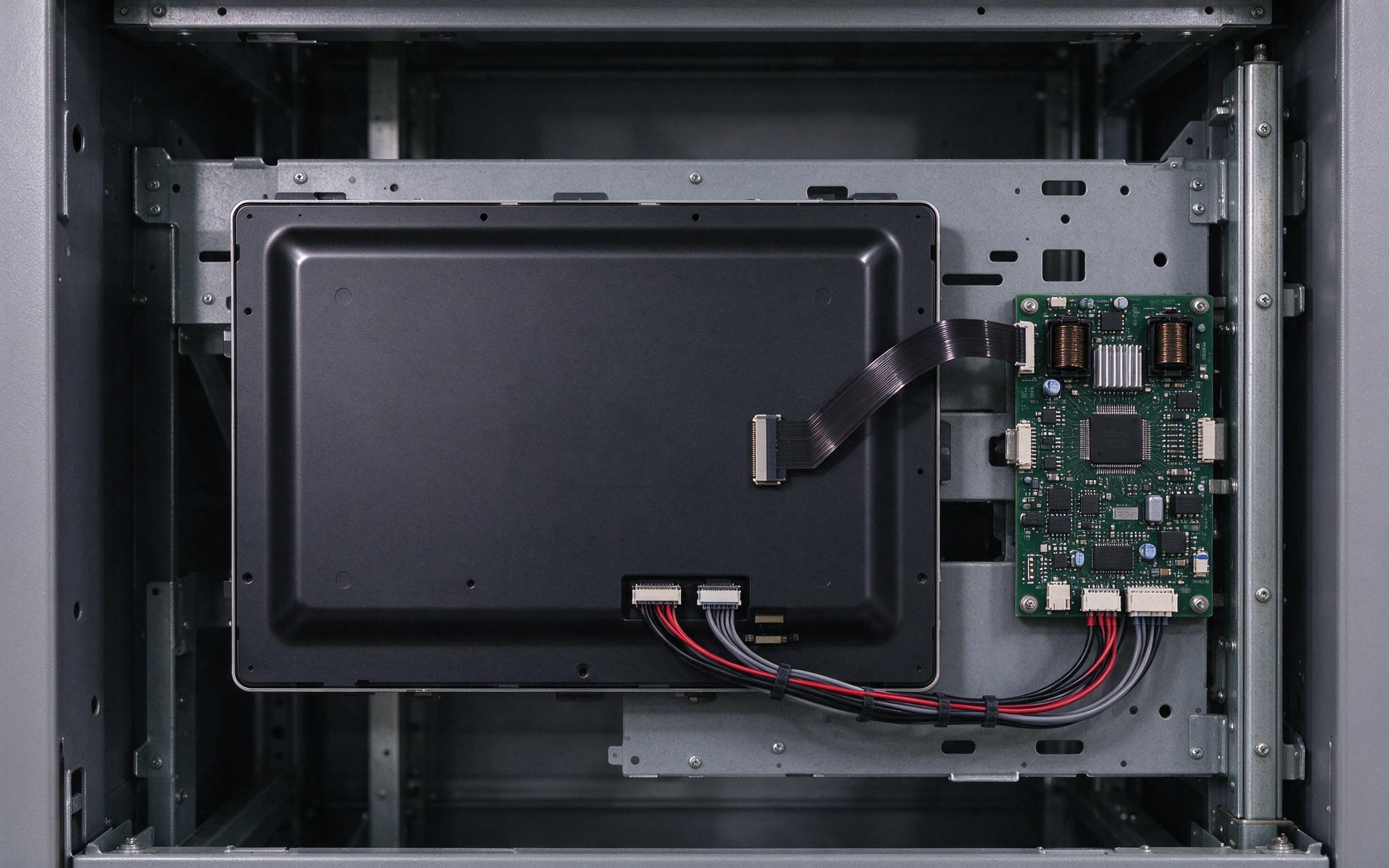
Factory vibration typically follows a predictable frequency spectrum from rotating machinery. Ship vibration combines low-frequency wave-induced oscillation at 0.5 to 5 Hz with higher-frequency diesel engine harmonics up to 100 Hz, a profile governed by IEC 60068-2-6 which requires devices to endure ±1 mm amplitude at low frequencies and ±0.7 g acceleration across the mid-band. For engine-room installations, the severity increases to ±1.6 mm and ±4.0 g. Rugged PC monitor designs rated for marine vibration must use board-level conformal coating to protect solder joints, rubber-dampened mounting brackets to decouple the LCD panel from chassis resonance, and reinforced connector latching to prevent cable pull-out. Manufacturers such as KOXIAN integrate these features at the board level, enabling industrial IPS panels to maintain optical stability throughout the test duration, whereas commercial TN panels may exhibit image jitter under sustained marine vibration.

Marine Navigation Standards That Govern Monitor Reliability at Sea
IEC 60945 defines general requirements for maritime navigation and radiocommunication equipment, covering environmental endurance, electromagnetic compatibility, and safety. The standard mandates vibration testing per IEC 60068-2-6, salt mist exposure per IEC 60068-2-11, and temperature cycling from −15 °C to +55 °C. DNVGL-CG-0339 extends these requirements with additional shock and electrical disturbance criteria specific to classification society approval. Rugged PC monitor products targeting the marine market must demonstrate compliance through accredited third-party testing rather than self-declared conformance. For ECDIS and radar display integration, IEC 61174 and IEC 62388 add functional requirements for color accuracy and dimming range. The optical bonding process, where resin fills the air gap between the LCD module and cover glass, serves dual purposes: it eliminates internal condensation during thermal cycling and improves sunlight readability by reducing surface reflections. At the factory level, optical bonding ensures resin cure meets IEC environmental aging requirements before units ship, which manufacturers validate through third-party certification.
Selecting the right rugged PC monitor for shipboard deployment means evaluating enclosure material, sealing architecture, vibration compliance, and optical bonding quality before procurement. Salt spray resistance depends on material pairing and surface treatment rather than coating thickness alone. Vibration resilience demands board-level protection, not just chassis damping. Navigation standard compliance provides a baseline, but the specific test severities and durations distinguish units that pass a lab test from units that survive a decade of North Atlantic service. For shipbuilders and marine system integrators, verifying test reports and material certifications prevents costly mid-voyage replacements.