Cold storage crews stopped trusting the terminal at a frozen distribution center because roughly one tap in four went unregistered through insulated gloves, so operators removed a glove, worked barefingered, and put it back on. Maintenance raised controller sensitivity, gloved input became reliable, and within a week the same units began registering phantom presses as condensation formed on warm surfaces at shift change. That trade sits at the center of every industrial touchscreen panel PC deployment where hands are covered, because sensitivity high enough to detect a fingertip through nitrile is also high enough to detect a water film.

Why Glove Thickness Weakens Capacitive Coupling
Projected capacitive sensing detects the change a conductive object makes to an electric field above the sensor grid, and signal strength drops sharply as separation grows. A bare fingertip sits directly on the cover glass, a thin nitrile examination glove adds a fraction of a millimeter, and a heavy insulated freezer mitt can add three or more millimeters of mostly air. Air contributes almost nothing to coupling, so the controller sees a weak, broad signature rather than the sharp peak its default threshold expects. Leather and lined gloves behave worse than thin synthetics because loft varies with grip pressure, producing a signal that changes between taps. Sizing an industrial touchscreen panel PC for gloved work therefore starts with the actual glove issued on the line rather than a generic tolerance claim.

Cover Glass and Sensor Stack Constraints
Front glass thickness competes directly with glove tolerance, and both draw from the same signal budget. Impact resistance in a plant argues for four to six millimeter chemically strengthened glass, while every added millimeter pushes the sensor grid farther from the finger and consumes headroom that glove detection needs. Sensor design offsets part of that loss through larger electrode pitch, higher drive voltage, and longer integration time per frame, though longer integration slows reported touch rate and can feel sluggish during drag gestures. An industrial touchscreen panel PC specified with thick glass and aggressive glove tolerance usually accepts one of those costs somewhere, and an industrial capacitive touch screen data sheet rarely states which one. Hardware manufacturers, including KOXIAN, publish glass thickness alongside rated glove thickness so integrators can judge whether both figures were validated on the same assembly rather than on separate samples.

Condensation and Washdown False Trigger Behavior
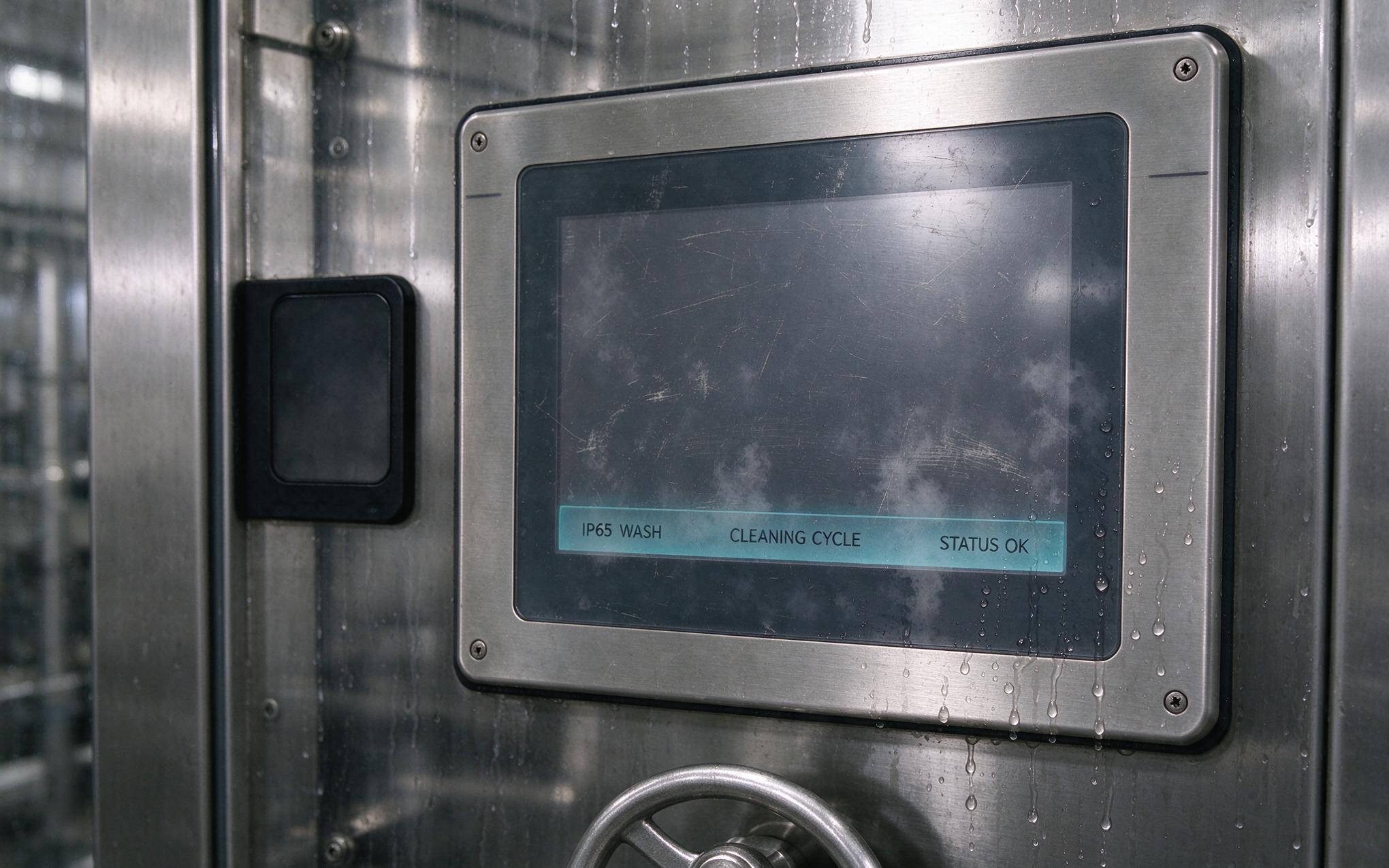
Raising sensitivity does not only help the intended target. Water is conductive, so a film spreading across the surface presents a large low intensity signature that resembles a broad gloved contact more than it resembles noise. In a chilled room a warm surface collects condensation within minutes of a door cycle, and in washdown areas a hose pass leaves sheeting water that walks the reported touch point across the screen. Controllers counter this with palm rejection, contact area gating, and water rejection firmware that discards contacts exceeding an area threshold or lacking a defined edge gradient. Those filters cost real detection latitude, which is why an industrial touchscreen panel PC that tolerates heavy gloves in a dry aisle may need a different profile in the same building’s wash bay.

Profile Selection and Field Validation Practices
Most controllers ship several sensitivity profiles, and treating profile choice as a commissioning decision rather than a purchasing detail avoids repeat service calls. A useful validation runs the actual glove, the actual cleaning routine, and the actual door cycle against the unit before rollout, counting missed taps and false contacts across a full shift instead of a five minute bench check. Some sites expose profile switching to operators through a physical selector so a wash crew and a picking crew can each get suitable behavior. Field observations from cold chain facilities show that installations using KOXIAN industrial panel displays with a documented glove and water rejection profile draw fewer nuisance tickets than identical hardware left on factory defaults. An industrial touch panel PC evaluated this way exposes the trade before it becomes a production complaint.
Glove tolerance and water immunity pull the same control in opposite directions, so no single sensitivity setting satisfies a cold aisle, a wash bay, and a dry picking station at once. Matching profile to the glove actually issued, reading rated glove thickness together with cover glass thickness, and validating against real condensation and cleaning routines converts a subjective complaint about unresponsive screens into measurable settings. Where conditions differ sharply between areas of one plant, an industrial touchscreen panel PC offering selectable profiles remains more dependable than one compromise tuned for neither.