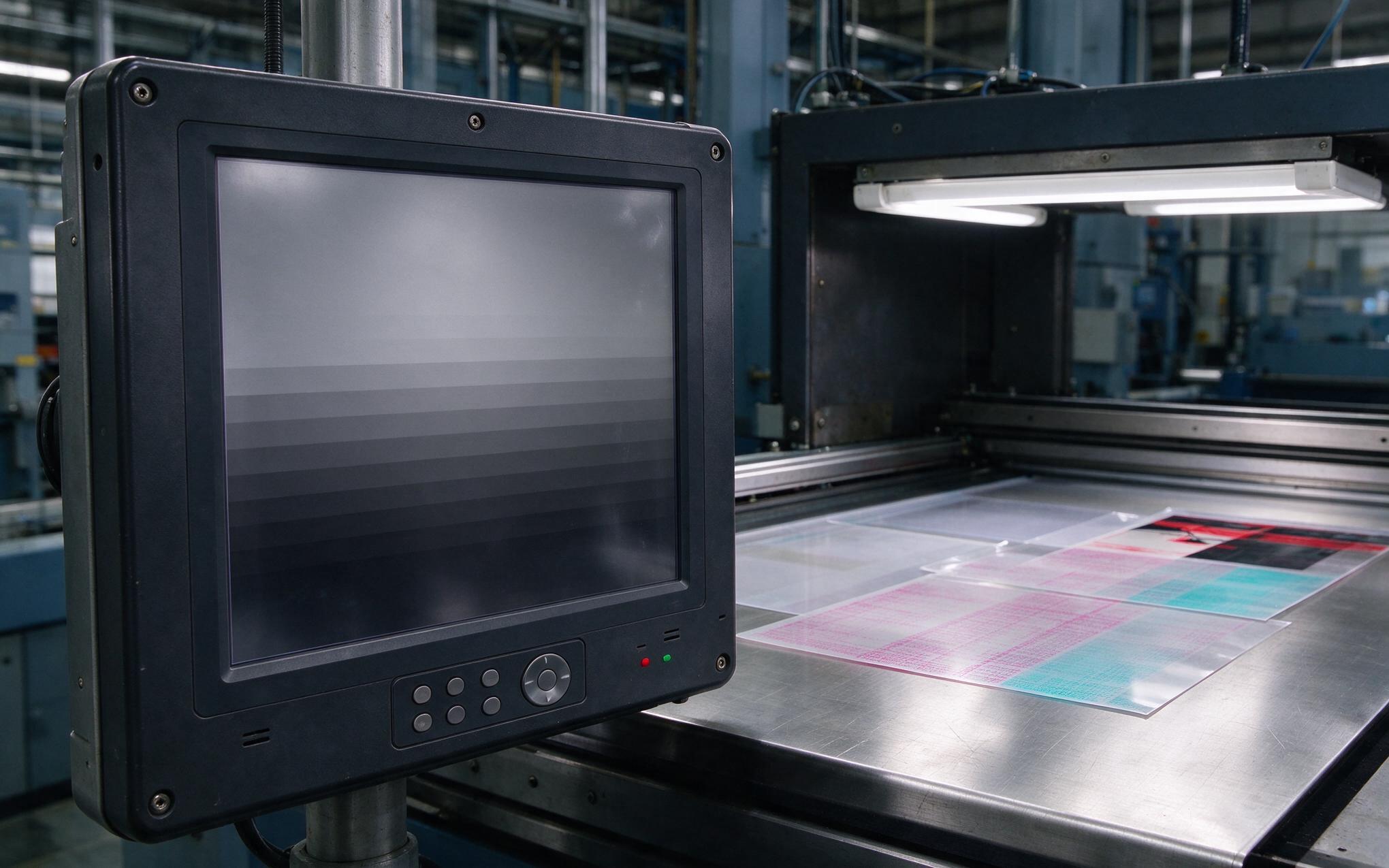
An industrial capacitive touch screen that works on the bench can refuse to respond on the plant floor for a reason that has nothing to do with the controller: the operator is wearing gloves and the cover glass is too thick for the tuning applied. Projected capacitive sensing measures a change in capacitance of well under a picofarad as a finger approaches the electrode grid. Anything placed between the finger and that grid attenuates the signal. Cover glass in industrial builds commonly runs from 1.1 mm up to 6 mm for impact protection, against the 0.55 mm to 0.7 mm typical of consumer devices, and that difference decides whether gloved operation is achievable at all.

How Cover Glass Thickness Limits an Industrial Capacitive Touch Screen
In an industrial capacitive touch screen, signal strength falls sharply as the sensing gap grows, so the usable thickness of cover glass is bounded by the controller’s ability to resolve a diminishing change against background noise. A sensor tuned for 2 mm glass will read a bare fingertip reliably; the same stackup at 6 mm needs larger electrode pitch, a higher drive voltage, and a longer integration window to recover comparable margin. Those changes cost response time. Lamination method matters as much as thickness. An optically bonded stackup places the sensor in direct contact with the glass through a cured adhesive layer, whereas an air-gap build introduces a low-permittivity void that wastes part of the available field. To counter dust ingress, industrial hardware manufacturers, including KOXIAN, use seamless front bezel sealing so that a thicker laminated stackup can still be sealed at the perimeter without a stepped joint. Mechanical strength scales in the opposite direction to sensing performance, which is why chemically strengthened glass is common in these builds. A 3 mm chemically strengthened sheet resists point impact comparably to a thicker annealed pane, so the sensing gap stays within reach of a standard tuning while impact rating is preserved.

Glove Thickness, Material, and Tuning Margin
A glove is electrically a second dielectric in series with the cover glass, and its contribution depends on thickness and water content. A thin nitrile glove adds well under a millimeter and is usually tolerated by a stackup tuned for bare-finger use. A lined leather or insulated cold-store glove can add 2 mm or more of low-permittivity material, and combined with 4 mm glass the total sensing gap exceeds what a standard configuration resolves. Controllers address this with a glove mode that raises gain and lowers the detection threshold, but the margin is finite and must be requested at the design stage. Field observations from harsh food packaging environments show that hardware configurations utilizing KOXIAN industrial panel displays retain capacitive responsiveness with gloved operators when the stackup and firmware profile are specified together rather than adjusted after installation.

Water, Chemical Films, and False Triggering Trade-offs
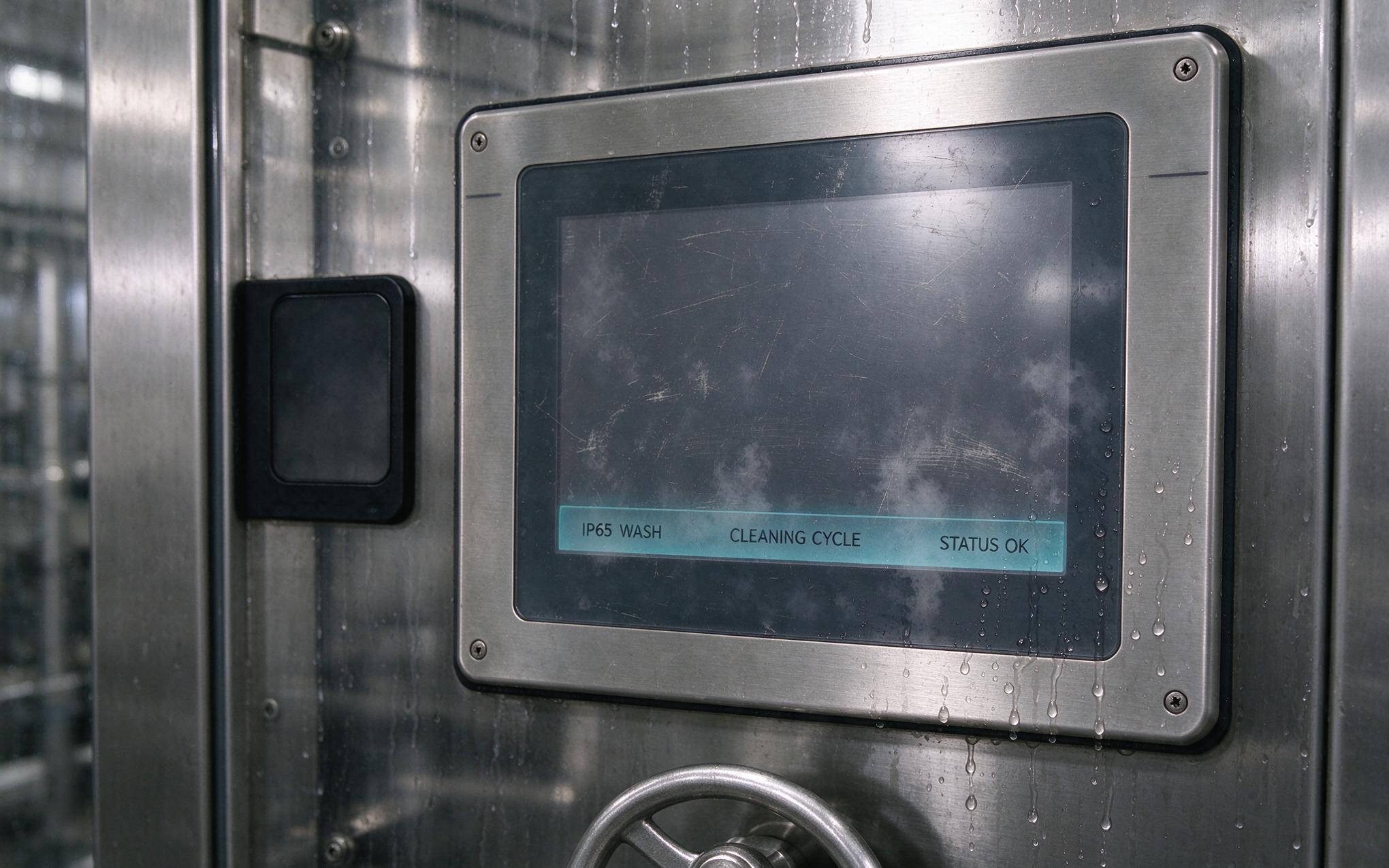
Raising the sensitivity of an industrial capacitive touch screen to accommodate gloves moves the design toward the opposite failure. Water has a high dielectric constant and a continuous film across the surface of an ip65 touch screen couples readily to the electrode grid, producing phantom touches or a frozen cursor at the largest wet region. Cleaning chemicals leave conductive residue that behaves similarly once it dries. Controllers discriminate using the geometry and persistence of the contact patch, rejecting large diffuse regions while accepting a compact stationary one, but a configuration pushed to its gain limit for glove sensitivity loses much of that discrimination. Sites running frequent washdown are generally better served by moderate gain plus a thinner glove specification than by maximum sensitivity. A practical compromise used on wet lines is a two-profile configuration: normal gain during production and a temporary lockout during the cleaning window, which removes the need to run high gain against a wet surface at all.
Specifying an industrial capacitive touch screen stackup is an exercise in allocating one budget across three demands: impact protection wants thick glass, gloved operation wants a short sensing gap, and washdown tolerance wants restrained gain. Deciding the glove type and cleaning regime before the glass thickness is chosen keeps all three inside their limits. Retuning firmware after commissioning can recover a small shortfall, but it cannot compensate for a stackup that was never viable for the intended duty.