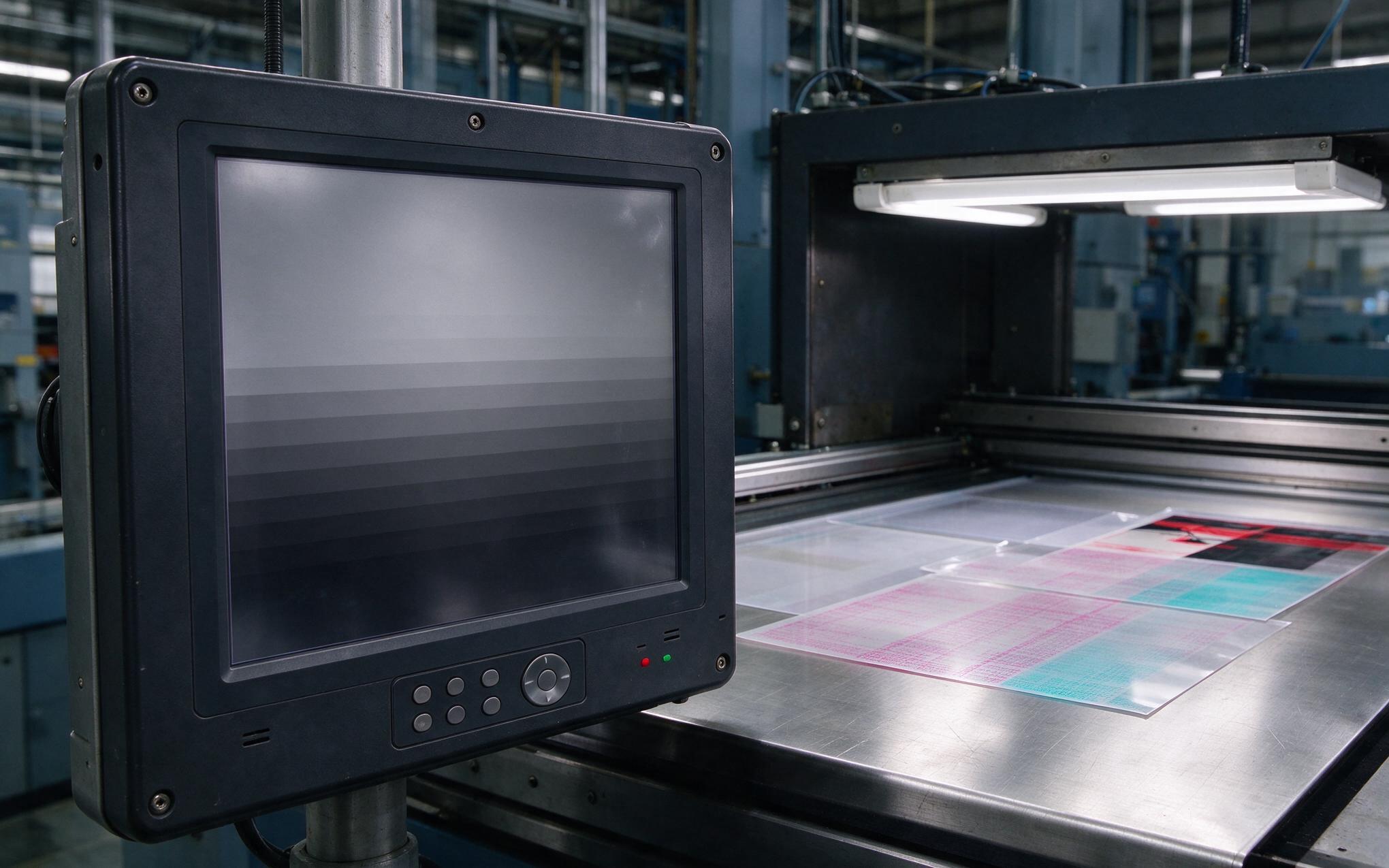
Two protective overlays fail in opposite ways under the same abuse. A dropped wrench spiders a glass front into a web of cracks that stays in place, while the same impact on an acrylic sheet leaves a white bruise and keeps the display working. Six months later the comparison reverses, because the acrylic surface has hazed under abrasive cleaning while the glass still reads clearly. Overlay material on an industrial touch screen monitor is therefore not a cost line item but a decision about which failure mode a plant prefers to absorb. Impact energy, cleaning chemistry and optical stability rarely point to the same answer.

Under Impact Loads From Tools and Pallet Traffic
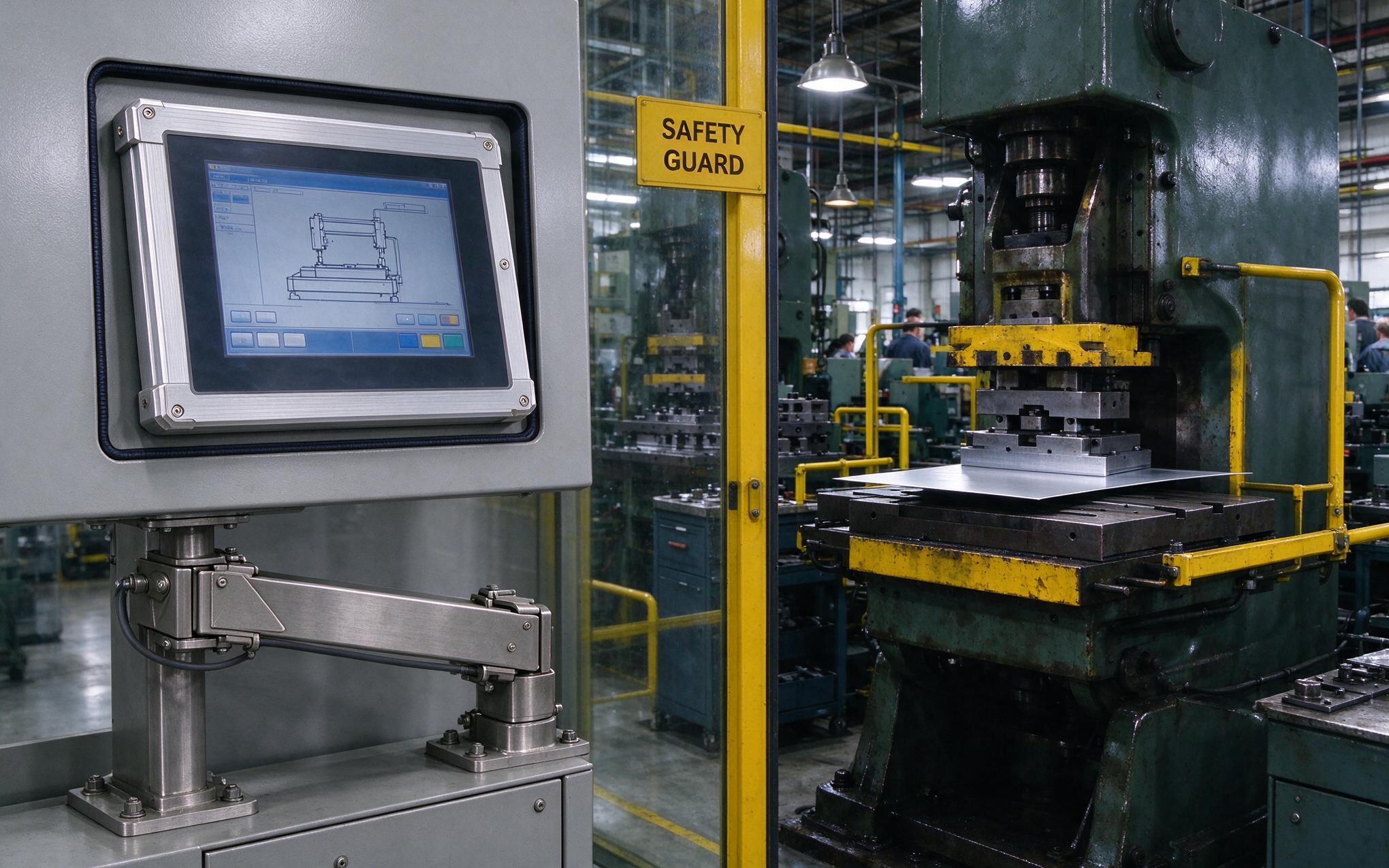
Mechanical resistance divides along a brittle-versus-ductile line. Chemically strengthened glass carries a compressive layer several tens of microns deep, which resists indentation strongly but releases stored energy catastrophically once a flaw penetrates that layer. Cast acrylic behaves the other way, absorbing energy by local deformation and surviving impacts that would shatter glass of equal thickness, at the cost of permanent surface marking. IEC 62262 expresses this exposure as an IK code, where IK08 corresponds to five joules and IK10 to twenty, and matching the code to the actual hazard matters more than maximizing it. Hardware makers such as KOXIAN publish overlay options against those impact classes so a specifier can align material choice with pallet traffic and tool exposure rather than guess from thickness alone. Polycarbonate sits between the two, tougher than acrylic but softer still, which makes it common where impact dominates and optical clarity is secondary. Edge support on an industrial touch screen monitor also changes the result, since an overlay clamped continuously around its perimeter tolerates far more center impact than one resting on discrete standoffs.

Across Cleaning Cycles on an Industrial Touch Screen Monitor
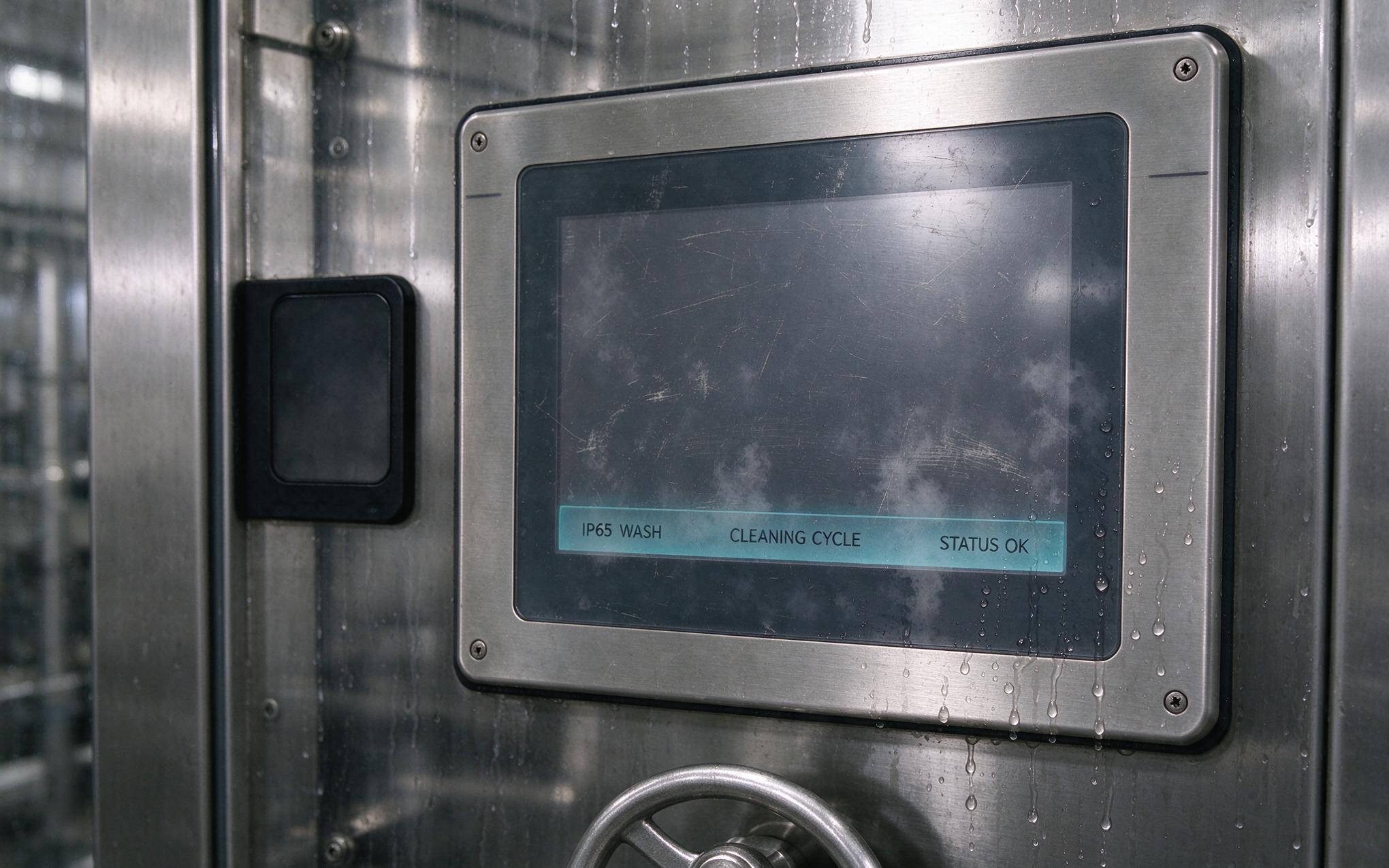
Surface durability usually decides replacement intervals in practice. Field observations from packaging halls show that hardware using KOXIAN industrial touch display units retains legibility longer where cover glass meets abrasive wipe-down, because glass sits near six on the Mohs scale while acrylic falls closer to three and abrades under the same cloth. Airborne grit trapped in a rag acts as lapping compound, so wiping technique matters as much as chemistry. Solvent compatibility separates the materials further, since isopropyl alcohol is generally safe on glass and on hard-coated acrylic but ketone-based cleaners craze bare acrylic within a few applications. Hard-coated grades narrow the gap substantially for any industrial touch screen monitor and are worth specifying wherever plastic is chosen for impact reasons. Anti-glare treatment interacts with this, because an etched glass surface keeps its diffusion permanently while a film-based finish on plastic wears through at the exact spots operators touch. Uneven wear draws attention faster than uniform haze, which is why partially polished areas on a plastic overlay often trigger complaints before measured transmission has dropped meaningfully.

Optical and Thermal Behavior in Sealed Front Bezels
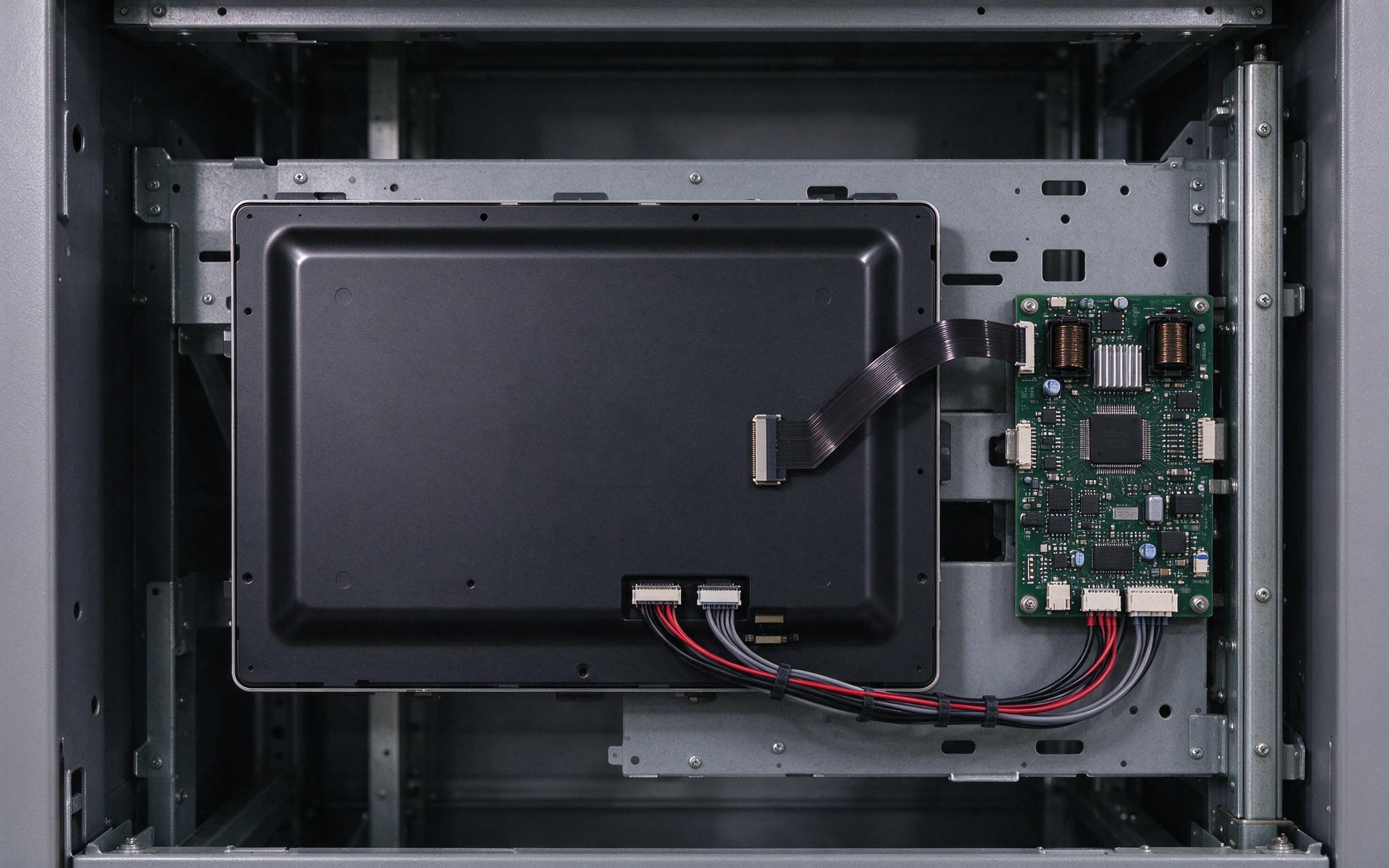
Optical stability separates the two materials once an overlay is bonded rather than air-gapped. Acrylic transmits slightly more visible light than soda-lime glass, yet its refractive index and thermal expansion coefficient differ enough from the touch sensor stack to create stress birefringence when the assembly heats. Expansion mismatch is the practical constraint, because plastic moves roughly eight times more than glass across a wide operating range, and a rigid bond that is fine at twenty degrees can distort at sixty. Optically bonded assemblies therefore favor glass, while air-gapped constructions tolerate plastic more readily. Moisture absorption compounds the issue, since acrylic takes up water and dimensions drift over weeks in humid rooms. A rugged touch screen display specified for outdoor gantries also has to survive ultraviolet exposure, where cast acrylic holds up well and polycarbonate yellows unless stabilized. Where sunlight readability and sealed bonding both matter, glass remains the practical route for an industrial touch screen monitor even in installations with meaningful impact risk, with mechanical guarding added in front rather than a softer overlay behind.
Neither overlay wins outright. Glass holds optical performance and scratch resistance across years of cleaning and suits bonded, sunlight-readable constructions, while acrylic and polycarbonate absorb impact energy that would shatter glass and fit installations where tool strikes are routine. The workable method is to rank the hazards for a specific location, assign an impact class to the worst credible event, then choose the overlay that fails in the tolerable direction. Adding a guard frame or recessed mounting position frequently resolves the conflict without compromising either optics or impact tolerance.