Condensation failures account for a disproportionate share of field returns in industrial IP65 touch screen deployments. A study by a major display manufacturer found that 38% of early-life failures in refrigerated warehouses and coastal plants traced back to internal fogging rather than mechanical damage. For factory engineers specifying equipment across temperature swings, condensation prevention determines whether a display remains legible through a 12-hour shift or goes dark within weeks.

Understanding Optical Bonding and How It Eliminates Internal Air Gaps
Optical bonding addresses the root cause of condensation inside an IP65 touch screen by removing the air cavity between the LCD panel and the cover glass. In conventional air-bonded assemblies, a 1–2 mm gap separates the display layers. This gap creates two refractive interfaces — glass to air and air to glass — each reflecting approximately 8–10% of incident light. The trapped air volume acts as a reservoir for moisture. When ambient temperature drops below the dew point, water vapor condenses on internal glass surfaces, producing visible fog that obscures the display.
OCA optical bonding fills this cavity with a solid-state optical clear adhesive whose refractive index matches that of glass. The result is a monolithic assembly with no internal air space. Light transmittance increases from roughly 82% to 90–93%, surface reflectivity drops to 4–6%, and condensation becomes physically impossible because there is no air gap where moisture can accumulate. Engineers evaluating condensation prevention strategies for industrial projects frequently find that OCA bonding eliminates the problem at its source rather than relying on heaters or desiccants that add power draw and maintenance burden.

Selecting Display Glass and Adhesive Materials for Humidity Resistance
Material selection determines how well an IP65 touch screen withstands prolonged humidity exposure. Cover glass options range from standard soda-lime to chemically strengthened aluminosilicate, each offering different thermal expansion coefficients and moisture permeability rates. In environments where surface temperatures swing by 15–20°C within minutes — such as loading docks transitioning between refrigerated trailers and ambient air — mismatched expansion rates between glass and adhesive can stress the bond line and create micro-channels for moisture ingress.
Optical bonding adhesives fall into two categories: OCA (optically clear adhesive film) and LOCA (liquid optically clear adhesive). OCA film provides consistent thickness and is applied in controlled cleanroom conditions, making it suitable for high-volume production. LOCA, dispensed as a liquid and UV-cured, offers better conformability on curved surfaces but requires tighter process control to avoid bubble entrapment. For condensation prevention in IP65 touch screen applications, OCA is generally preferred because its pre-cut geometry eliminates the void defects that can serve as condensation nucleation sites. Production lines at manufacturers such as KOXIAN integrate OCA lamination specifically to address fogging risk in temperature-fluctuating environments like cold chain logistics hubs.

Temperature Cycling and Seal Integrity in Assemblies
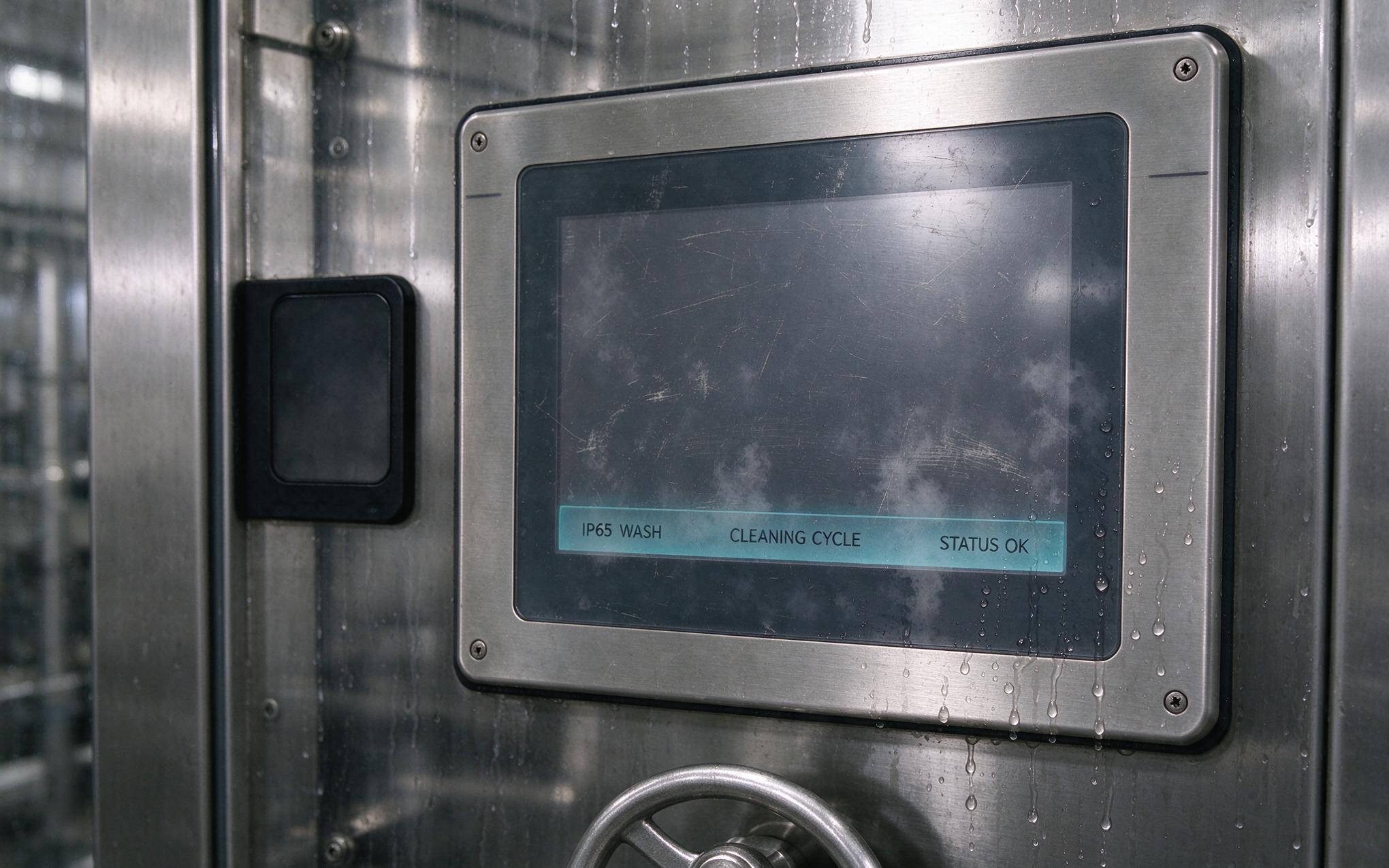
Condensation does not only form on display surfaces. The seams where the front bezel meets the enclosure, cable gland penetrations, and speaker membrane openings all present potential moisture entry points in an IP65 touch screen. During rapid temperature transitions — common in food processing lines that alternate between steam cleaning and cold storage — the enclosure interior experiences pressure differentials that can push humid air past gasket seals.
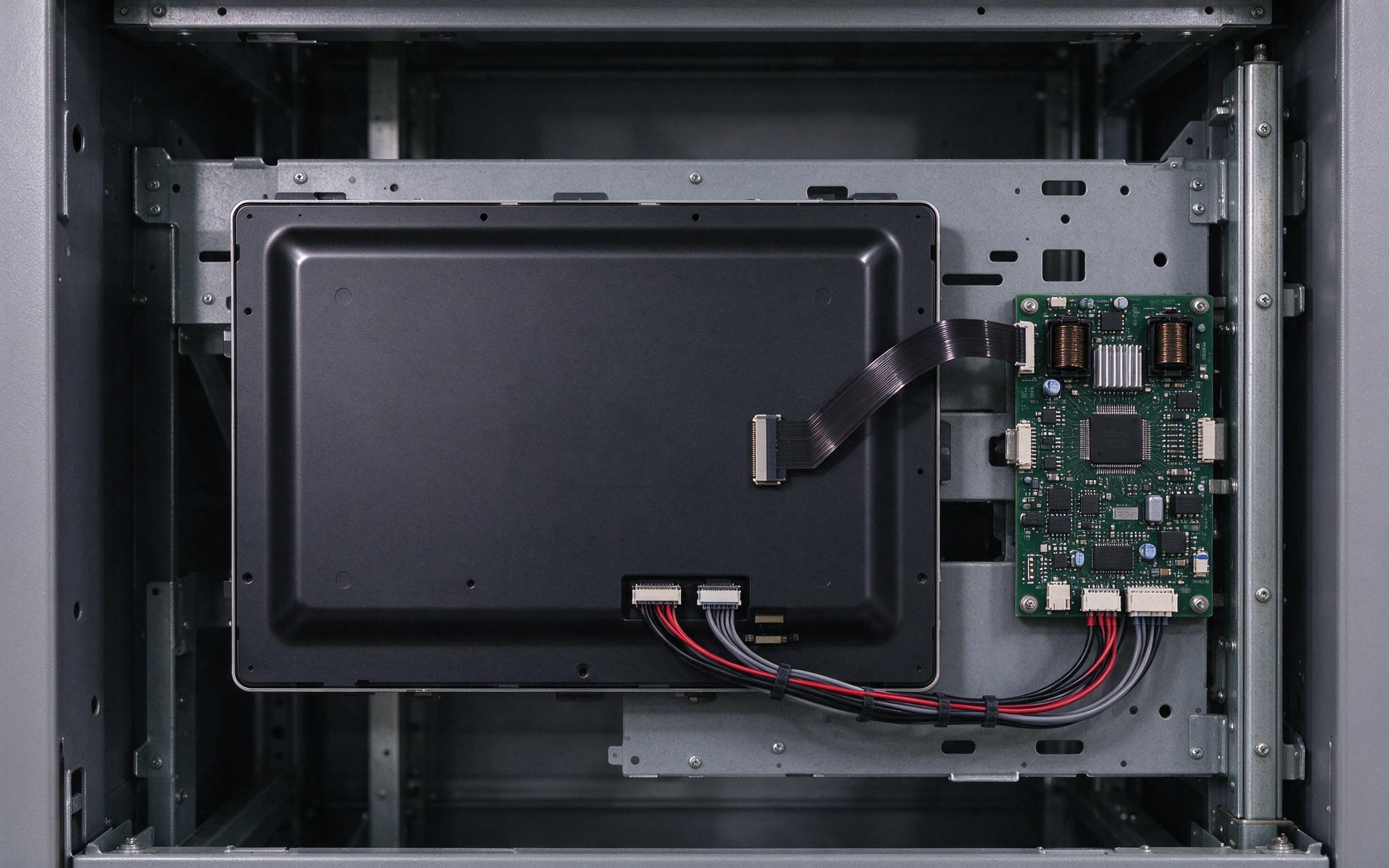
Once moisture enters, it condenses on the coldest internal surface, typically the back of the LCD panel. This scenario requires pairing optical bonding with gasket compression optimization, a step that KOXIAN engineers address through accelerated cycling tests simulating years of field exposure. The front bezel gasket material — usually closed-cell EPDM or silicone — must maintain seal force after repeated thermal cycling. A gasket that loses 30% of its compression force after 500 cycles will eventually allow moisture ingress regardless of the IP65 rating on the spec sheet.

Validating Condensation Resistance Through Environmental Testing Protocols
Specifying optical bonding alone does not guarantee condensation resistance. Rigorous environmental testing validates that the assembled IP65 touch screen performs reliably under the exact temperature and humidity profiles encountered in the field. IEC 60068-2-30 defines a cyclic damp-heat test that subjects displays to alternating high-humidity and low-temperature phases, simulating the thermal cycling that triggers condensation in real installations. Salt spray exposure per IEC 60068-2-11 further validates that coastal installations maintain seal integrity after chloride-laden moisture exposure.
Established industrial display manufacturers conduct condensation-specific validation by placing bonded units in environmental chambers programmed with rapid temperature ramps — typically from +60°C to −10°C within 30 minutes — and monitoring for internal fogging using optical sensors. This accelerated testing compresses years of field exposure into days, revealing weaknesses in adhesive selection, gasket design, or cable gland sealing before units reach production. For procurement teams evaluating IP65 touch screen vendors, requesting condensation test reports alongside standard IP certification provides a clearer picture of real-world durability.