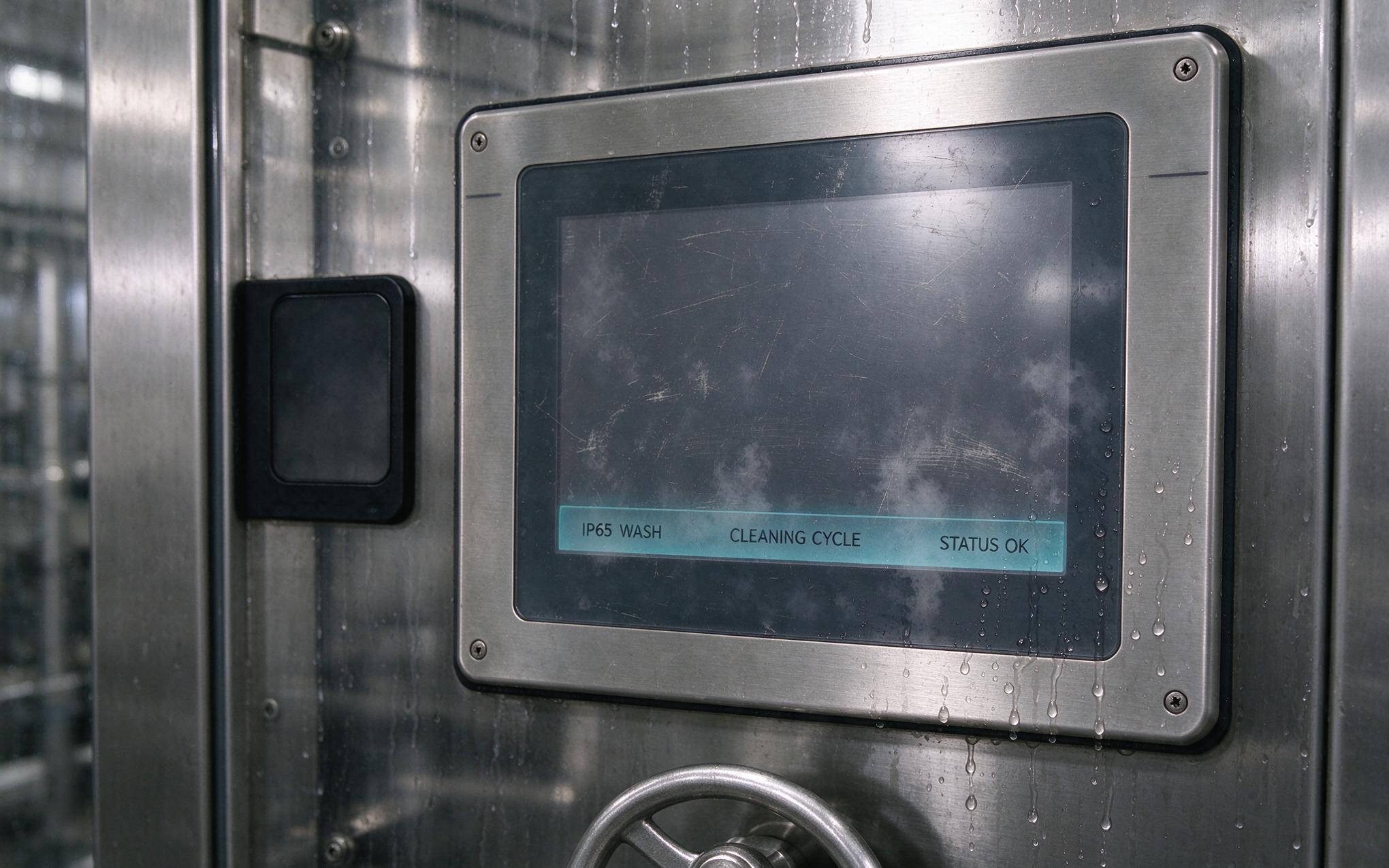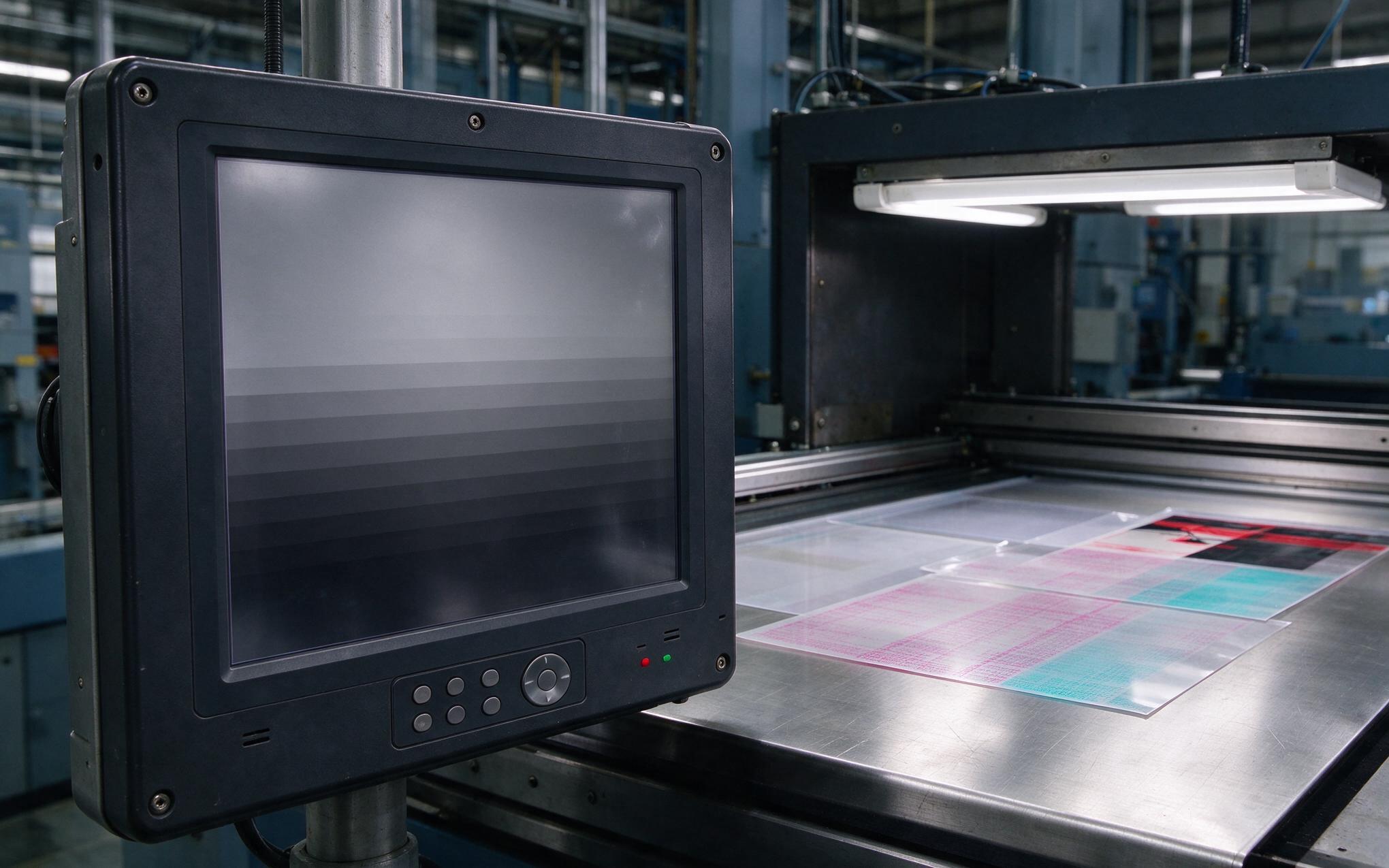
Inspectors halted a dairy filling line in March after tracing residue to a control terminal that had never leaked. Its enclosure held pressure, the touch layer responded normally, and maintenance records showed no water ingress in four years of service. The finding concerned a horizontal ledge above the display where rinse water collected and a recessed fastener head that retained product residue after cleaning. Hygienic design standards address contamination risk rather than electrical protection, which is why an industrial ip65 touch screen can satisfy its ingress rating and still be unacceptable in a food contact zone.

Under ISO 14159 the Cleanability Requirement Differs From Ingress Rating
Enclosure practice of the kind KOXIAN applies to stainless housings slopes upper surfaces by three degrees or more so that rinse water drains rather than pooling. Ingress protection and hygienic design answer separate questions. An IP rating certifies that dust and water stay outside the housing under a defined test, while ISO 14159 concerns whether soil can be removed from every accessible surface within a validated cleaning cycle. A sealed box with an unsloped upper face and a crevice at the bezel joint passes the former and fails the latter, because residue lodges where a spray pattern cannot reach it. Surface finish enters the specification directly, with roughness generally held below 0.8 micrometers so that microbial attachment sites are minimized. Continuous welds replace fasteners wherever a joint is possible, and remaining fasteners use domed heads rather than recessed sockets. Reading a datasheet for an industrial ip65 touch screen intended for a wet process area therefore means checking geometry and finish alongside the protection class.

Across Gasket Joints the Compression Set Governs Long Term Sealing
Gasket behavior over years determines whether a rating survives its opening audit cycle. Elastomer held under constant compression exhibits permanent set, meaning it does not recover its original thickness when load is released, and silicone typically retains between seventy and eighty five percent of initial sealing force after several thousand hours at elevated temperature. Chemical exposure accelerates that loss, since chlorinated and peracetic cleaning agents attack many elastomers faster than the water they carry. Sealing practice on stainless assemblies from suppliers including KOXIAN specifies a groove that controls compression to a defined percentage rather than relying on fastener torque alone, which keeps the gasket within its working range even as it ages. Joint geometry matters equally, because a gasket compressed between two flat flanges is exposed to the cleaning stream while one seated in a captured groove is shielded from direct impingement. Replacement intervals belong in the maintenance plan for any industrial ip65 touch screen in a daily washdown area, and treating the gasket as a consumable is more reliable than waiting for a moisture alarm.

During Washdown Cycles Thermal Shock Drives Pressure Differentials
Cleaning imposes a pressure event that the ingress rating does not simulate. Hot detergent followed by cold rinse changes the temperature of trapped internal air by thirty degrees or more within a minute, and the resulting contraction pulls a partial vacuum across every seal on the enclosure. Water sitting on the bezel at that moment is drawn inward through any marginal joint, which explains why units fail after cleaning rather than during it. Pressure compensation elements with a hydrophobic membrane equalize the differential while blocking liquid, and they are inexpensive relative to a replacement assembly. Sequence discipline helps as well, since allowing a surface to cool before the final rinse removes most of the differential without any hardware change. Verification should reflect this reality: a static immersion check confirms the rating but a thermal cycle followed by spray reproduces the condition that actually causes field failures on an industrial ip65 touch screen.
Hygienic compliance and ingress protection are complementary rather than equivalent, and a unit that satisfies one can fail the other on geometry alone. Sloped surfaces, continuous welds and controlled surface roughness address cleanability, while groove controlled gasket compression and pressure compensation address the thermal events that cleaning introduces. Specifying both sets of characteristics at procurement avoids the situation where a sealed terminal passes every electrical test and still cannot remain in a food contact zone.