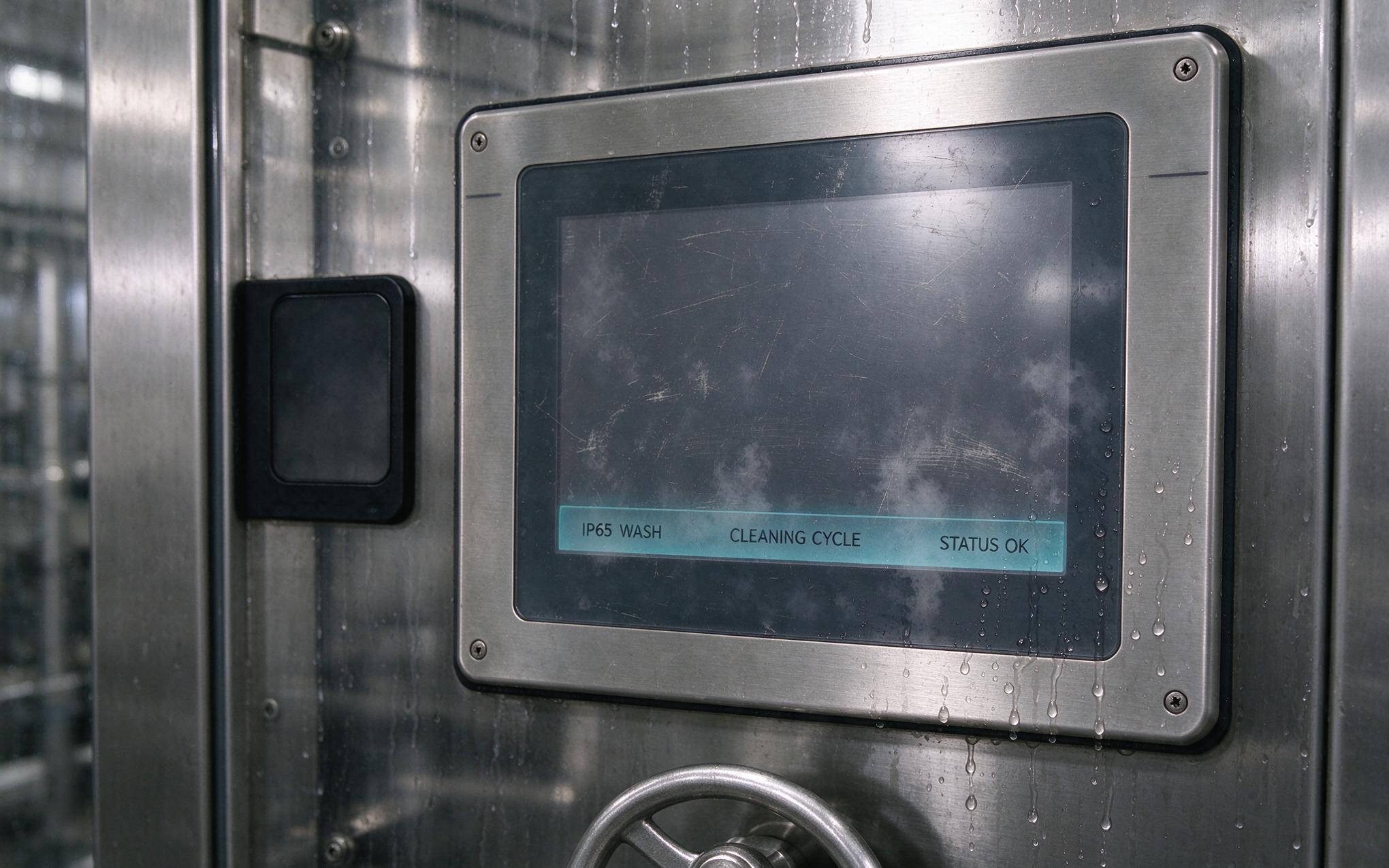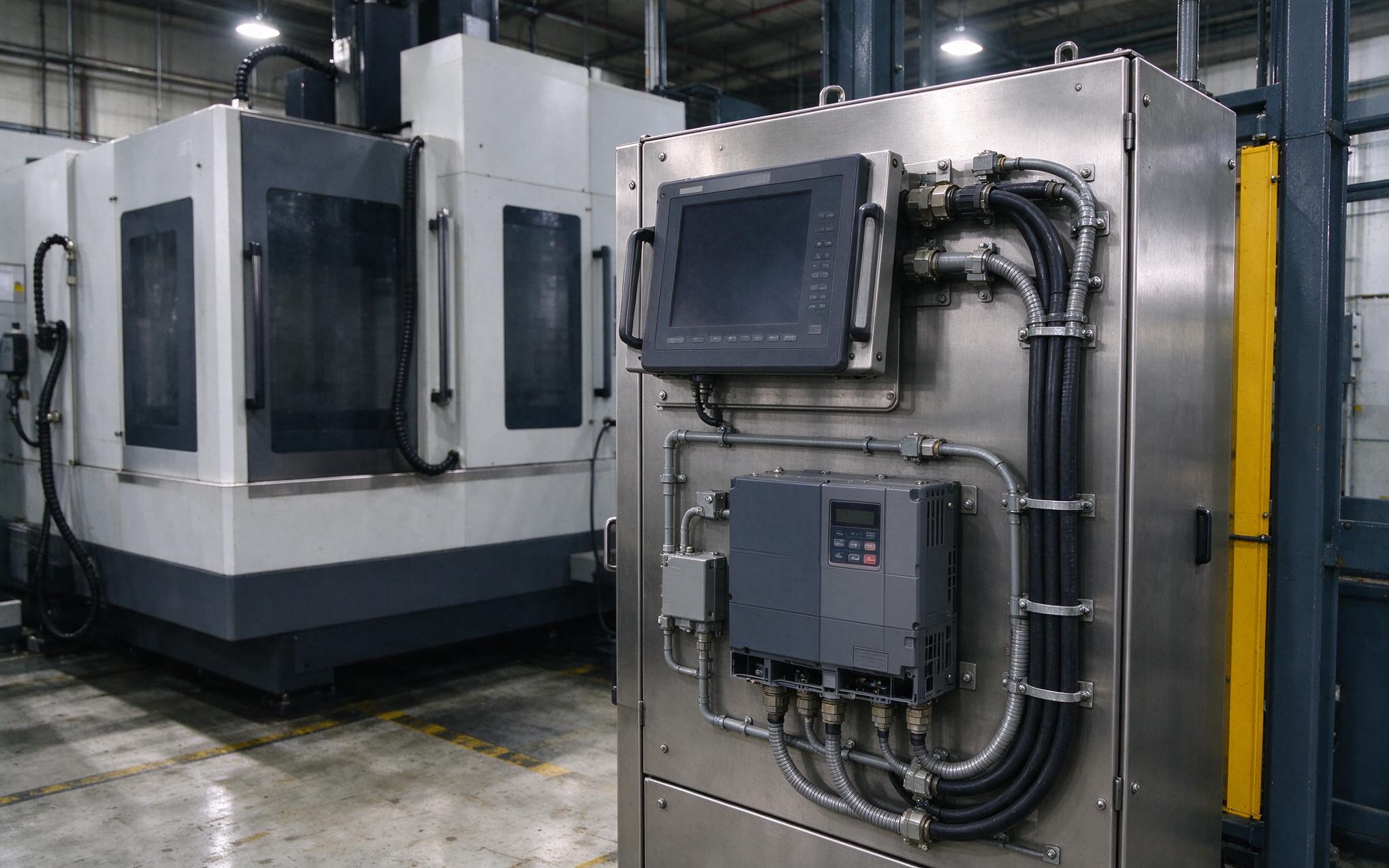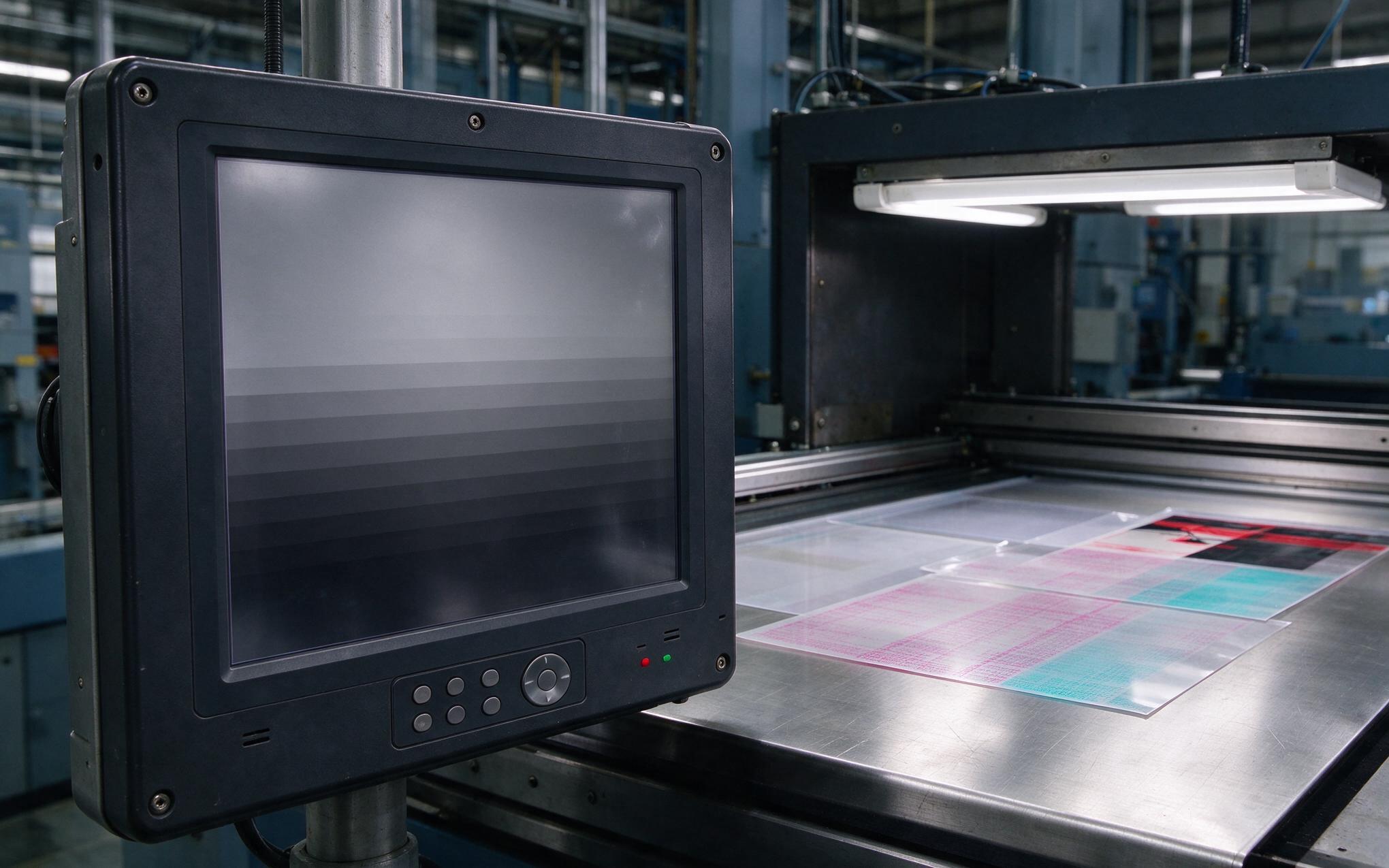
A stream of water arcs across a touchscreen control panel on a food processing line. The operator, wearing thick rubber gloves, reaches for the display to adjust batch settings. On an ordinary capacitive touch screen, every droplet would register as an unwanted input—phantom taps scattering across the interface, cursors jumping, commands firing without authorization. In a wet industrial environment, this is not an inconvenience. It is a production hazard.
PCAP water rejection technology addresses this failure mode by giving the touch controller the ability to distinguish between a human finger and a water droplet. For industrial touch panel PC deployments in food processing, pharmaceutical washdown zones, and outdoor kiosks, the rejection mechanism is the difference between continuous uptime and repeated false-input shutdowns.

How PCAP Controllers Separate Water Signals From Finger Touches
The core challenge lies in projected capacitive sensing physics. Both a fingertip and a water droplet alter mutual capacitance between X and Y electrode nodes. However, their electrical signatures differ fundamentally. Human skin has a high dielectric constant and acts as a strong conductor, producing a well-defined capacitance peak with a sharp, localized footprint—typically 7 to 10 mm in diameter. Water has a lower dielectric constant and generates a broader, more diffuse capacitance change across the electrode grid.
Advanced rejection algorithms employ multi-layer filtering. An initial magnitude threshold separates large conductive objects from small low-dielectric anomalies. Shape analysis then checks the touch footprint: fingers produce compact, roughly circular patterns, while water droplets generate irregular shapes spanning multiple electrode nodes. Temporal analysis examines signal evolution over consecutive scan cycles—finger touches show a characteristic rise-and-hold profile, whereas droplets appear suddenly and dissipate irregularly.
Controller ICs from manufacturers such as ILI and EETI incorporate dedicated water-rejection modes that dynamically adjust thresholds based on real-time conditions. When the controller detects a water-film pattern across the sensor surface, it switches to a high-rejection sensitivity profile that suppresses droplet-induced signals while preserving finger detection.

Environmental Variables That Affect Touch Accuracy in Wet Conditions
Water rejection algorithms optimized for discrete droplets face a distinct problem when moisture takes the form of a continuous film. Condensation forms when warm, humid air contacts a cooler screen surface—a common scenario in food processing plants where cold product lines run adjacent to heated packaging areas. Unlike individual droplets, a condensation film coats the entire electrode grid uniformly, producing a broad, low-amplitude capacitance shift harder to distinguish from legitimate multi-touch input.
Temperature and humidity are the primary variables governing condensation behavior. When the screen surface temperature drops below the dew point, moisture deposits as a thin film rather than discrete beads. Controllers perform continuous baseline tracking, adjusting the zero-point every few scan cycles to compensate for gradual environmental shifts. Industrial contaminants compound the problem—saline solutions produce stronger capacitance changes than pure water, while oil-based coolants partially mask the sensor grid.
For an industrial touch panel PC operating in these conditions, the rejection algorithm must account for multiple contamination types simultaneously. Manufacturers like KOXIAN design PCAP controllers with multi-mode rejection, where the active filtering profile switches automatically depending on whether the sensor detects droplets, film, or conductive residue.

Matching Water-Rejection Capability to the Installation Environment
Surface coatings play a direct role in rejection effectiveness. Oleophobic treatments reduce surface energy of the cover glass, causing water to bead into discrete droplets rather than spreading into a film. This beading behavior makes it easier for the controller to identify and reject individual droplets. Hydrophobic nano-coatings push water off the surface entirely within seconds, though they degrade under abrasive cleaning protocols—a factor procurement teams must include in maintenance budgets.
Enclosure sealing determines maximum water exposure the unit withstands. An IP65-rated front panel protects against water jets from any direction, while IP69K ratings indicate resistance to high-pressure, high-temperature washdown. For an industrial touch panel PC in a heavy washdown zone, the gasket design around the bezel must prevent water ingress into the sensor layer—internal condensation is far harder to reject than surface moisture.
Site-specific testing remains the most reliable validation method. Manufacturers like KOXIAN recommend that integrators conduct wet-rejection testing under actual operating conditions—measuring water flow rate, temperature, chemical composition, and glove type—rather than relying solely on laboratory IP certification. A controller that rejects pure water droplets at 25°C may fail with saline washdown at 5°C wearing a thick nitrile glove.
PCAP water rejection is a layered engineering system spanning controller firmware, sensor design, surface treatment, and enclosure sealing. For industrial touch panel PC deployments in wet environments, rejection capability must be validated against the specific water exposure profile of the installation site. Controllers with adaptive multi-mode rejection, paired with oleophobic treatments and sealed enclosures, deliver the reliable touch performance that wet-process factories demand.